What land is actually worth around Fort Worth
Seller Resources
Seller Resources
Here is a conversation I have several times a year.
Somebody owns twenty acres outside Weatherford or Springtown. A neighbor just sold two acres for $120,000 — $60,000 an acre. So the twenty acres must be worth $1.2 million.
They are not. They are probably worth somewhere around $450,000, and the reason is the single most useful thing I know about rural property.
I pooled 5,671 closed land sales across Tarrant, Parker, Hood, Johnson, Ellis, Wise and Denton counties for the three years ending September 2026. Here is what an acre costs, by how many of them you are buying:
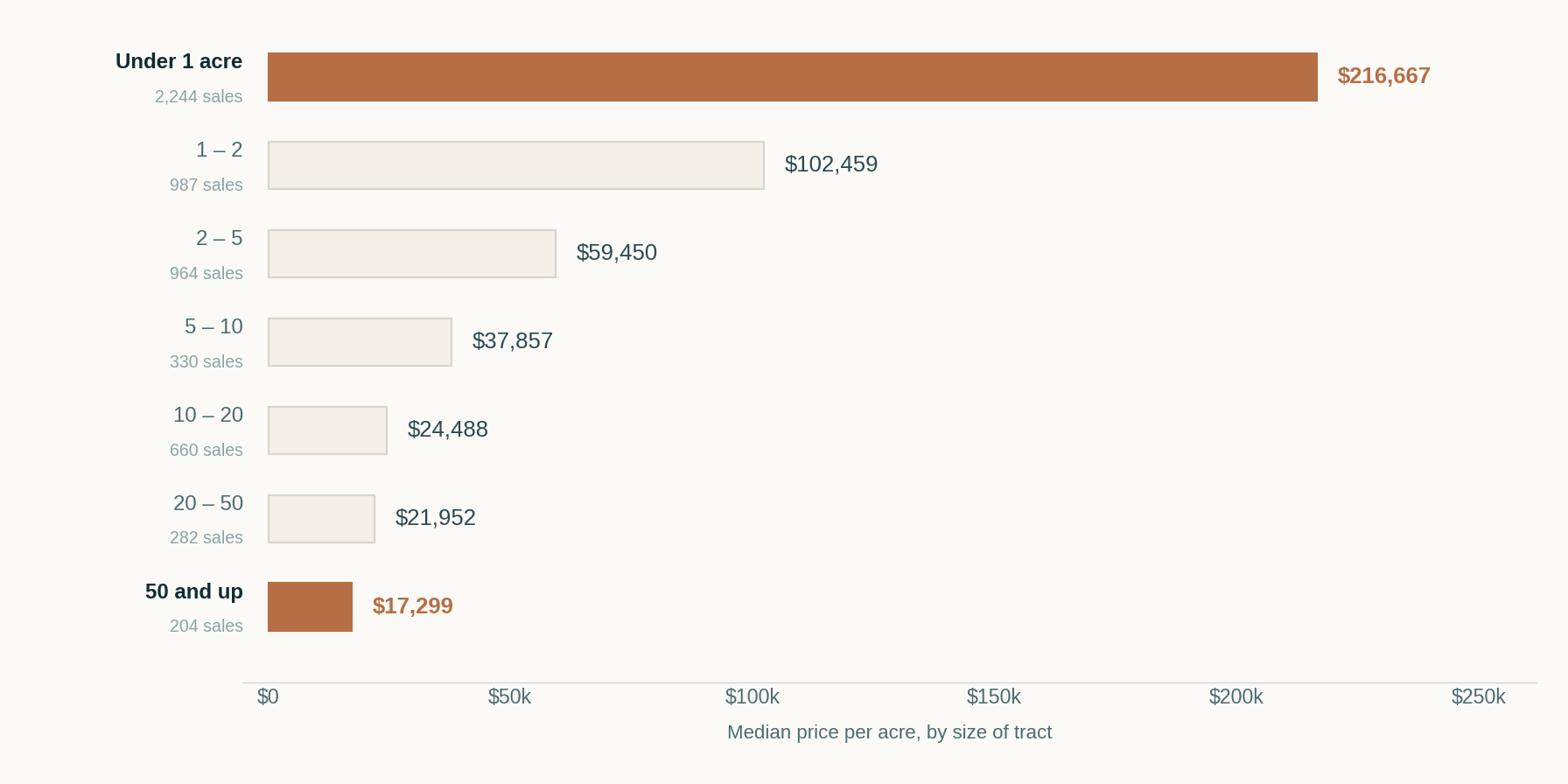
Median price per acre by tract size. 5,671 closed land sales, seven counties, 2023–2026.
Tract size | Sales | Median price | Per acre |
Under 1 acre | 2,244 | $60,000 | $216,667 |
1 to 2 acres | 987 | $144,000 | $102,459 |
2 to 5 acres | 964 | $165,000 | $59,450 |
5 to 10 acres | 330 | $300,000 | $37,857 |
10 to 20 acres | 660 | $305,000 | $24,488 |
20 to 50 acres | 282 | $650,000 | $21,952 |
50 acres and up | 204 | $1,513,250 | $17,299 |
Twelve to one, from the smallest parcels to the largest. And it is not a location story — the same shape holds inside every county in the data.
Run a model on it and the relationship is strikingly regular. Doubling the size of a tract raises its total price by about 52% — not 100%. Which means price per acre drops roughly a quarter every time the tract doubles.
The reason is that a parcel is not a stack of identical acres. The first one carries the road frontage, the utility connection, the septic area, the building site. Acres eleven through twenty carry none of that. They add room. Room is worth real money, but far less per unit than access.
So: two acres at $60,000 an acre implies twenty acres at closer to $22,000–$24,000 an acre. That is the $450,000 figure, and it is why the twenty-acre owner is usually disappointed and the two-acre owner is usually pleased.
Everybody reaches for price per square foot. On a subdivision street it is a fair shorthand, because every lot is the same and the house is the only thing that varies.
On acreage it falls apart. Here is the proof, from 89,302 residential closings, with house size held to 1,800–2,600 square feet so the house itself is roughly constant:
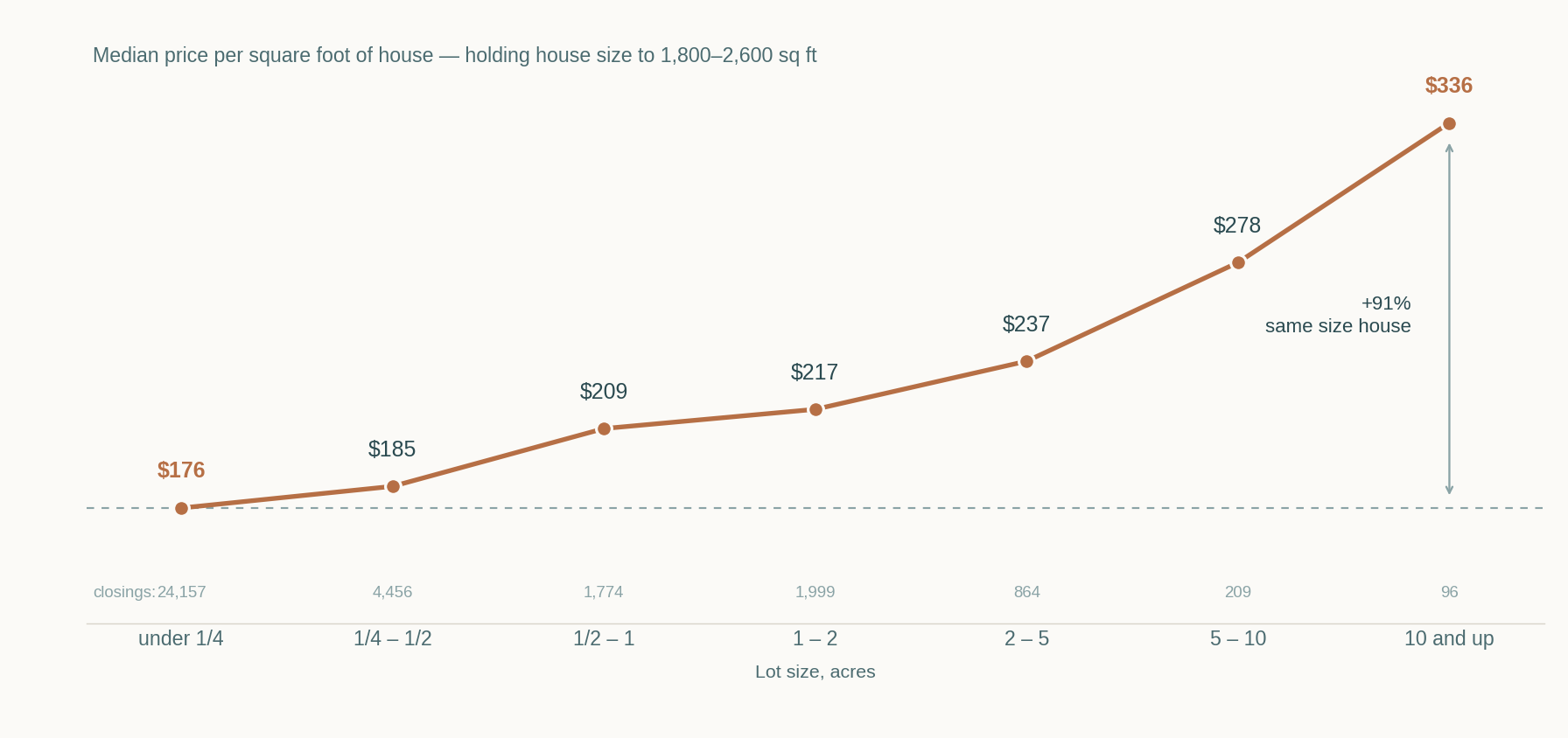
Same size house, different amount of ground. The 91% difference is the land.
A 2,200-square-foot house on a tenth of an acre trades at about $176 a foot. The same house on ten acres trades at about $336. The house did not improve. You are paying for the ground, and it lands on top of the house where the arithmetic makes it look like a premium.
When somebody tells you rural property "sells for more per foot," they have not found a premium. They have found land, described in the wrong unit. Value the site and the house separately, or you will misprice both.
This one surprises people, because bare land has no children in it. But land is bought by people who intend to build, and what they build into is a district.
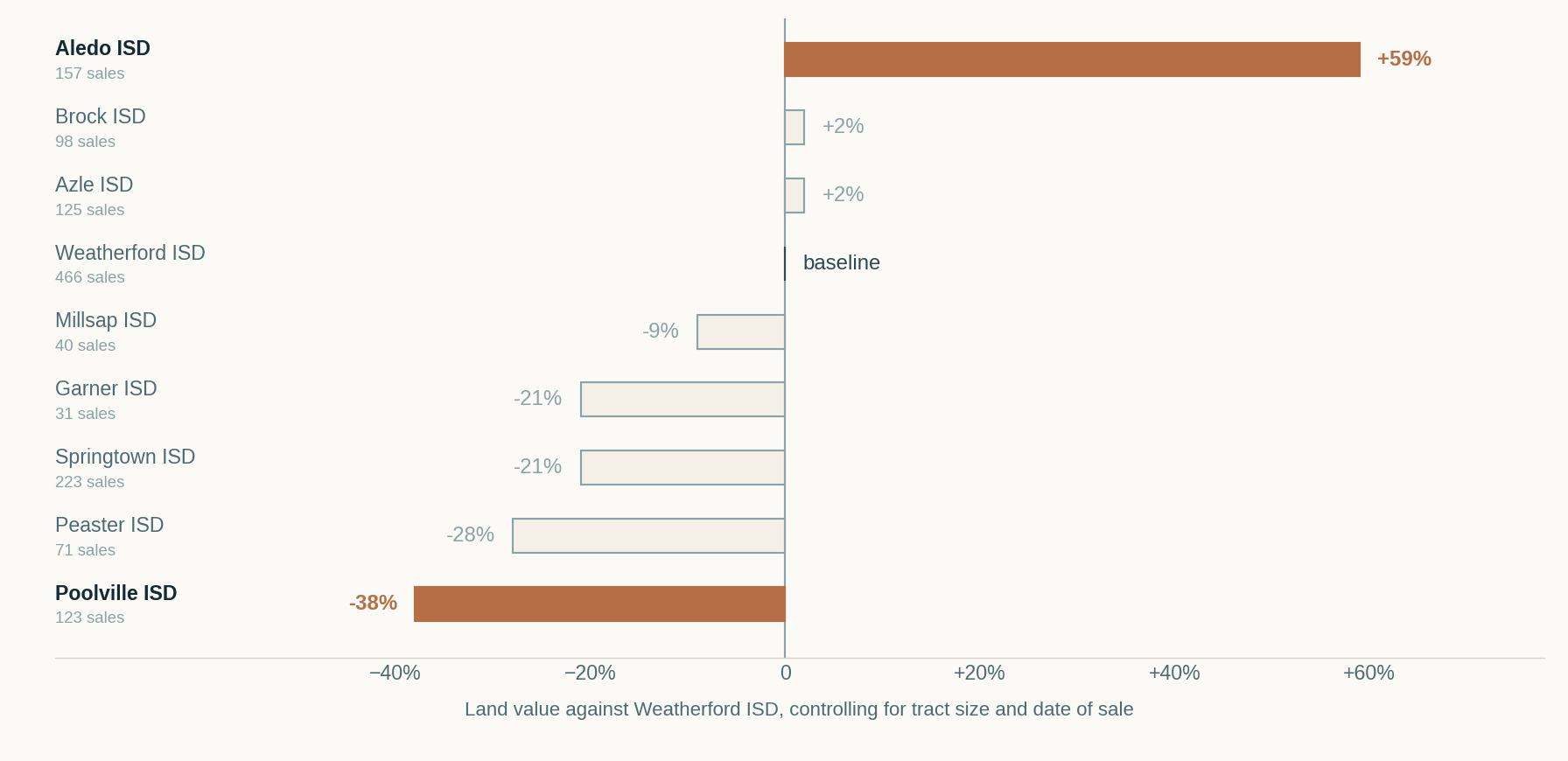
Parker County has enough sales to measure it. Holding tract size and sale date constant, against Weatherford ISD:
 Poolville ISD 36 percent below." width="1792" style="width:100%;height:auto;display:block" loading="lazy">
Parker County land by school district, 1,334 closed sales, controlling for tract size and date.
Land in Aledo ISD runs about 59% above Weatherford. Poolville runs about 38% below. That is better than a two-to-one spread for dirt in the same county, often twenty minutes apart. Brock and Azle sit level with Weatherford; Springtown and Peaster sit well below.
The gap is even wider elsewhere. In Tarrant County, land in Carroll ISD runs several times above Fort Worth ISD, with Grapevine-Colleyville close behind. In Johnson County, land in Burleson ISD runs about 85% above Cleburne, Joshua about 70% and Alvarado about 40%.
Practical consequence: a land comp from ten minutes away can be the wrong comp, and the line is invisible from the road. Confirm the district for the exact parcel before you price anything.
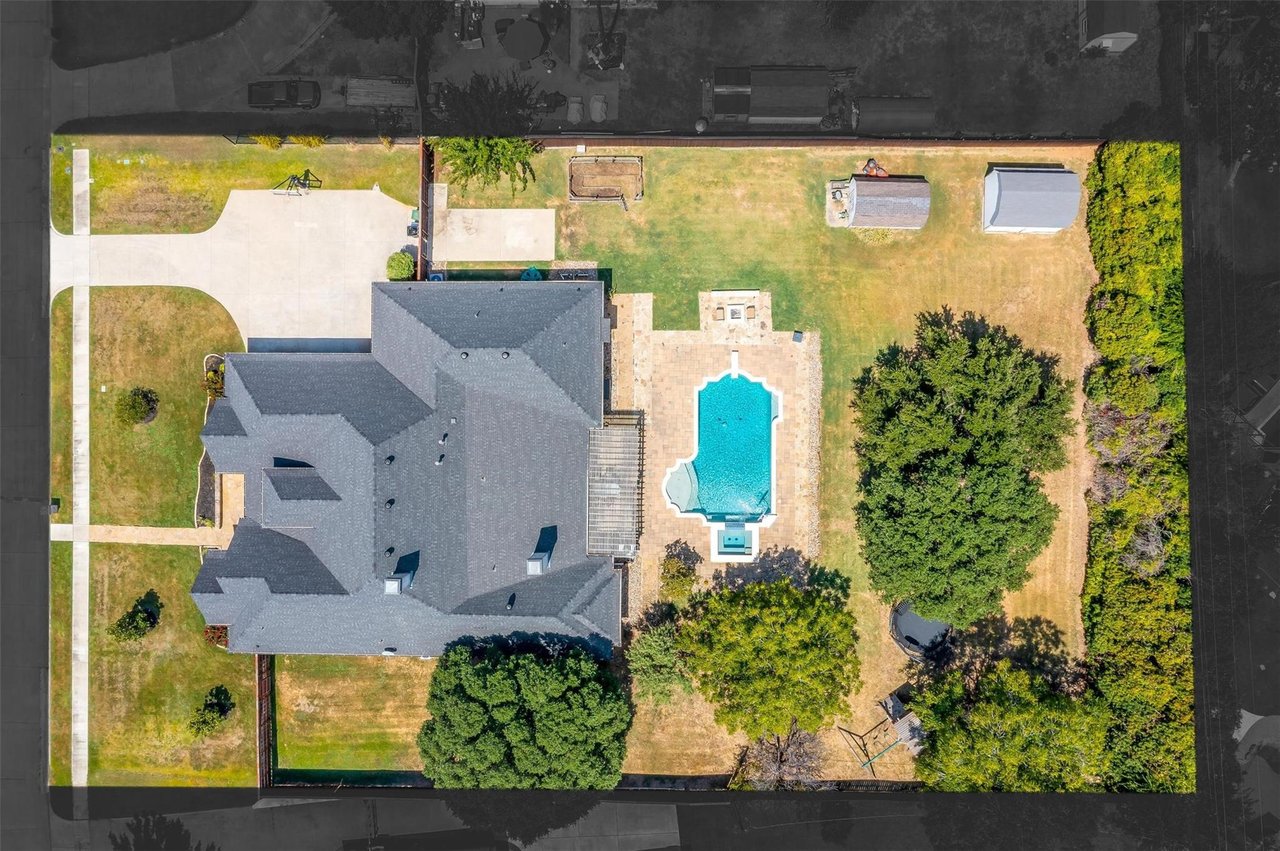
I showed a client an acreage property in Azle recently. Plenty of land on paper. Before we drove out I told her I didn't think it would work, from the aerial alone.
The parcel was an odd many-sided shape. It had several small ponds scattered through it. And the driveway ran straight down the middle of the best ground. She wanted a barn and a riding arena, and once you subtracted the water, the drive and the pieces too narrow to use, there was nowhere to put them. She walked it in person and agreed.
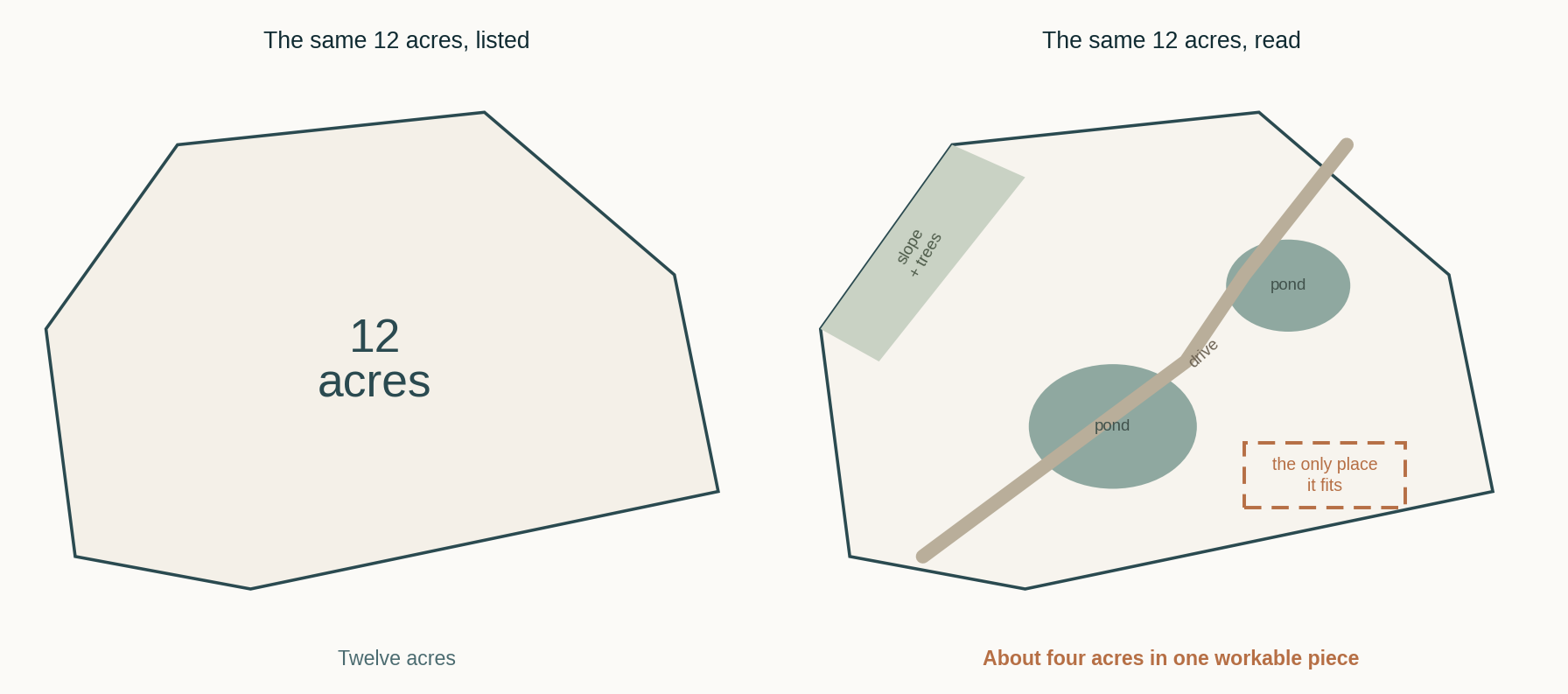
Gross acreage and usable acreage are different numbers, and only one of them is in the listing.
This is the part no listing tells you, and it is worth more than the acreage figure. So I went and checked whether the market agrees.
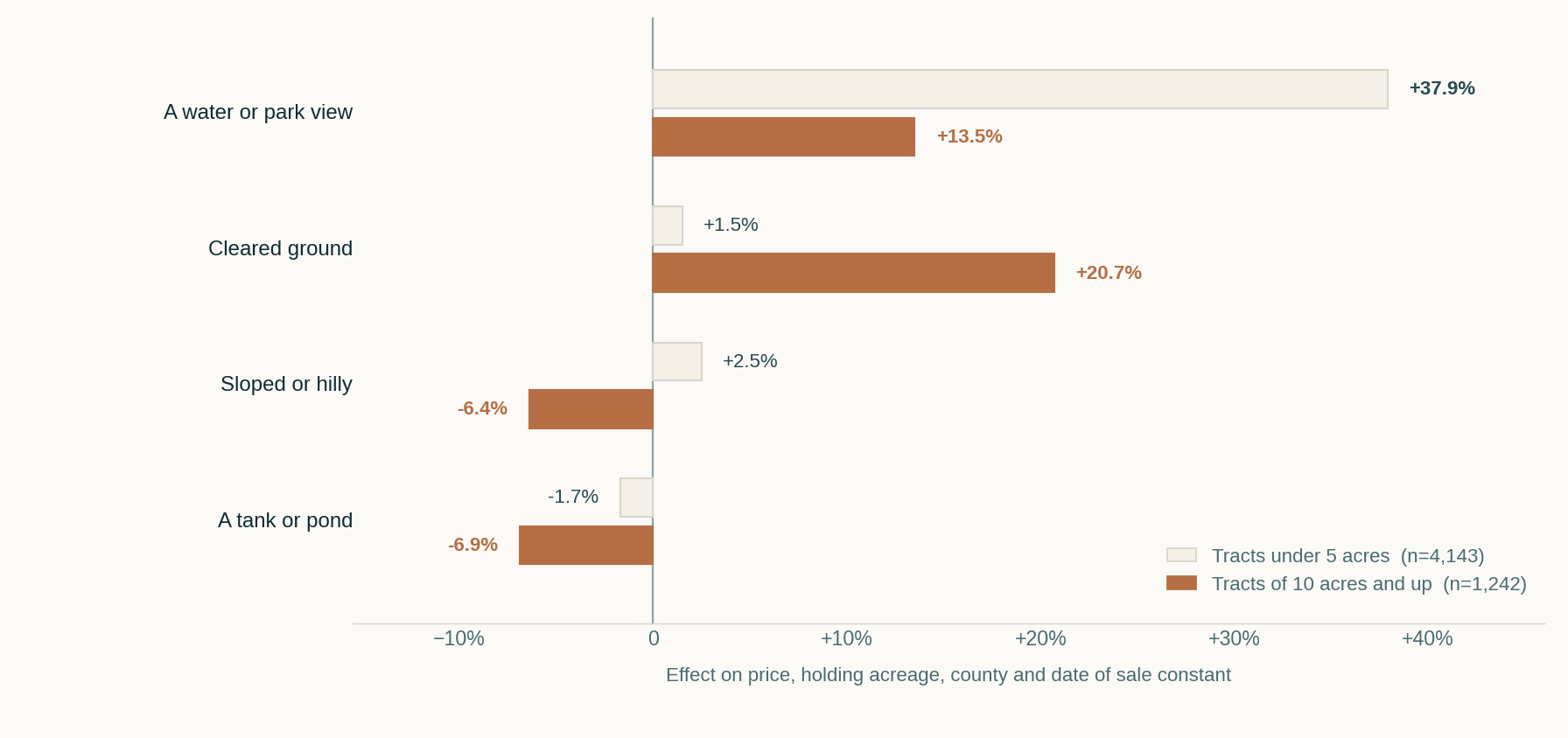
The same four features, priced differently depending on how much land is involved. Holding acreage, county and date of sale constant. 5,671 closed land sales.
It does, and it flips depending on how much land is involved.
On a small tract, you are buying the view. Under five acres, a water or park view is worth about +38%. Cleared ground, slope and ponds make no measurable difference at all — almost any small lot will hold a house, so what separates them is what you see from the porch.
On acreage, you are buying workable ground. At ten acres and up, cleared land is worth about +21%, slope costs about 6%, and a pond costs about 7%. The view premium drops to +13.5%.
That pond number surprises people every time. On a one-acre lot a pond is scenery. On fifteen acres it is very often sitting on the flattest, most accessible spot — exactly where you wanted the barn — and the market knocks the price down for it.
And here is the honest limit. I tried to measure the rest of it statistically and could not. I built a "usable" flag out of the listing tags and tested it, and it came back meaningless. The MLS field "Irregular Lot" predicts nothing whatsoever. Because the tag records that a parcel is oddly shaped — not that the drive bisects the only flat ground, not that the usable area is four disconnected pieces, and certainly not that you wanted an arena.
Usable land isn't a feature of the property. It's a feature of the property and what you intend to do with it. Twelve acres is generous for a house and a shop and useless for an arena, and it is the same twelve acres either way. Every one of these is its own research problem, which is why I look at the aerial, the flood map and the topography before we get in the car, and why I will tell you not to bother driving out to something.
This is the number that should change how you list.
Of 18,153 land listings taken since January 2023 across those seven counties, only about 31% closed. The rest expired, cancelled or withdrew. For comparison, the house failure rate across the markets I track runs closer to one in five. Land is roughly three times harder to sell.
And the ones that do sell work for it: a median 69 days on market, closing at 90.9% of original list price. Houses in the same window close at about 97%. Bigger tracts take longer — a median 56 days under two acres, about 100 days above twenty.
Here is the part that sits oddly next to everything above. Controlling for tract size and county, land values are up about 6.3% a year over the window. County by county: Parker +6.1%, Hood +7.2%, Johnson +7.1%, Tarrant +7.1%.
That average hides a lot, and the spread between towns is wider than the spread between years. Over the same window, land in Weatherford rose about 14% a year while land in Springtown, twelve miles up the road, fell about 6%. Granbury is up about 9%. So the 6.3% is the middle of a very wide distribution rather than a number to apply to a particular parcel.
Now set that against the houses. When I tested 40,703 closings across nineteen markets, houses on subdivision lots were falling about 1% a year while houses on an acre or more were rising. The land is doing the work in both datasets.
Illiquid and appreciating at the same time is not a contradiction. A thin market with few buyers can still be a rising one, because price is set by the transactions that happen, not by the ones that do not. For an owner, patience is simply the price of the appreciation.
Most rural land around here carries what everyone calls an "ag exemption." It is not an exemption — it is 1-d-1 open-space valuation, where the county assesses the land on what it can produce agriculturally instead of what it would sell for. The tax bill can be a fraction of what market value would produce.
Two things worth knowing.
That county figure is not a market value. It is a productivity value calculated for taxation. It is not evidence of what the land is worth, and it should not anchor your expectations in either direction.
Taking land out of agricultural use triggers a rollback. The taxing units recapture the difference between what was paid and what would have been paid at market value. Since HB 1743 took effect on September 1, 2019, that recapture covers three years plus 5% interest, down from five years and 7%. Lighter than the old rule, but on a tract with a wide gap between productivity and market value it is still real money — and it lands on whoever owns the property when the use changes. Ask the county appraisal district and your tax advisor before you close, not after.
Price it off tracts of similar size. Not off the small parcel down the road. If the only comps are a different size, the price has to be moved along the size curve, and anyone who cannot show you that adjustment is guessing.
Plan on months, not weeks. A 31% sale rate and a median 69 days means the overpriced listing does not correct — it expires. Most land that fails to sell fails on price, not on the property.
Remove the questions. Survey, septic feasibility or existing system, water and electric availability, deed restrictions, floodplain, and whether access is deeded. Every unanswered question is a discount a buyer builds in, and it is always bigger than the cost of answering it.
Do not annualize the small-tract per-acre price. You already know why.
Ask how much of it is usable — for what you actually want to do. Floodplain, slope, bottomland, timber, ponds, road frontage, where the drive runs, and whether the workable ground is in one piece or five. Twelve acres of pasture and twelve acres of creek bottom are not the same twelve acres, and the market prices that difference at more than twenty percent.
Confirm the school district for that parcel, not for the mailing address.
Ask about the ag status and the rollback exposure before you write the offer.
I am a Texas broker and a Certified Residential Appraiser, which means on rural property I can tell you what the closed sales on tracts like yours actually support — with the land valued separately from whatever is standing on it, and the size adjustment shown rather than asserted.
If you want the full technical treatment, including the regressions behind the district figures and how I approach the valuation itself, I wrote it up on my appraisal practice's site: what an acre is worth around Fort Worth.
Browse active listings in this price range, or call or text (682) 207-4310, or send me a note.
Figures are medians and model results from NTREIS land and residential listings and closed sales across Tarrant, Parker, Hood, Johnson, Ellis, Wise and Denton counties for the three years ending September 2026, reported in aggregate. Land leases are excluded. Size bands above twenty acres rest on 282 and 204 sales, so the shape of the curve is well supported though the figures at that end are the least precise. Tax and statutory references are general information rather than tax advice; confirm agricultural status, rollback exposure and school district boundaries for a specific parcel with the county appraisal district and your tax advisor. Nothing here is an appraisal or a valuation of any particular property.
 Tanglewood
 Crestwood
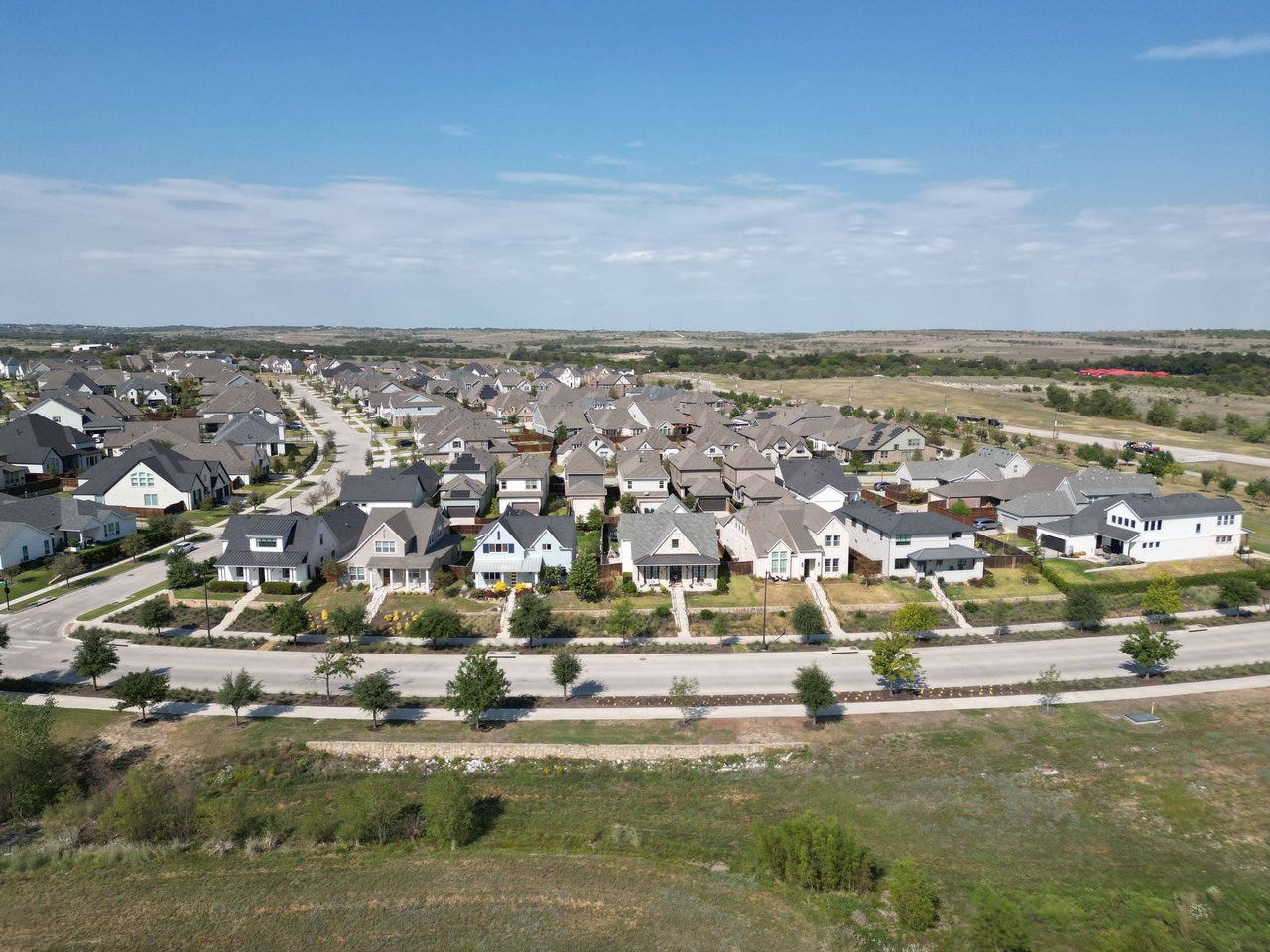 Walsh Ranch
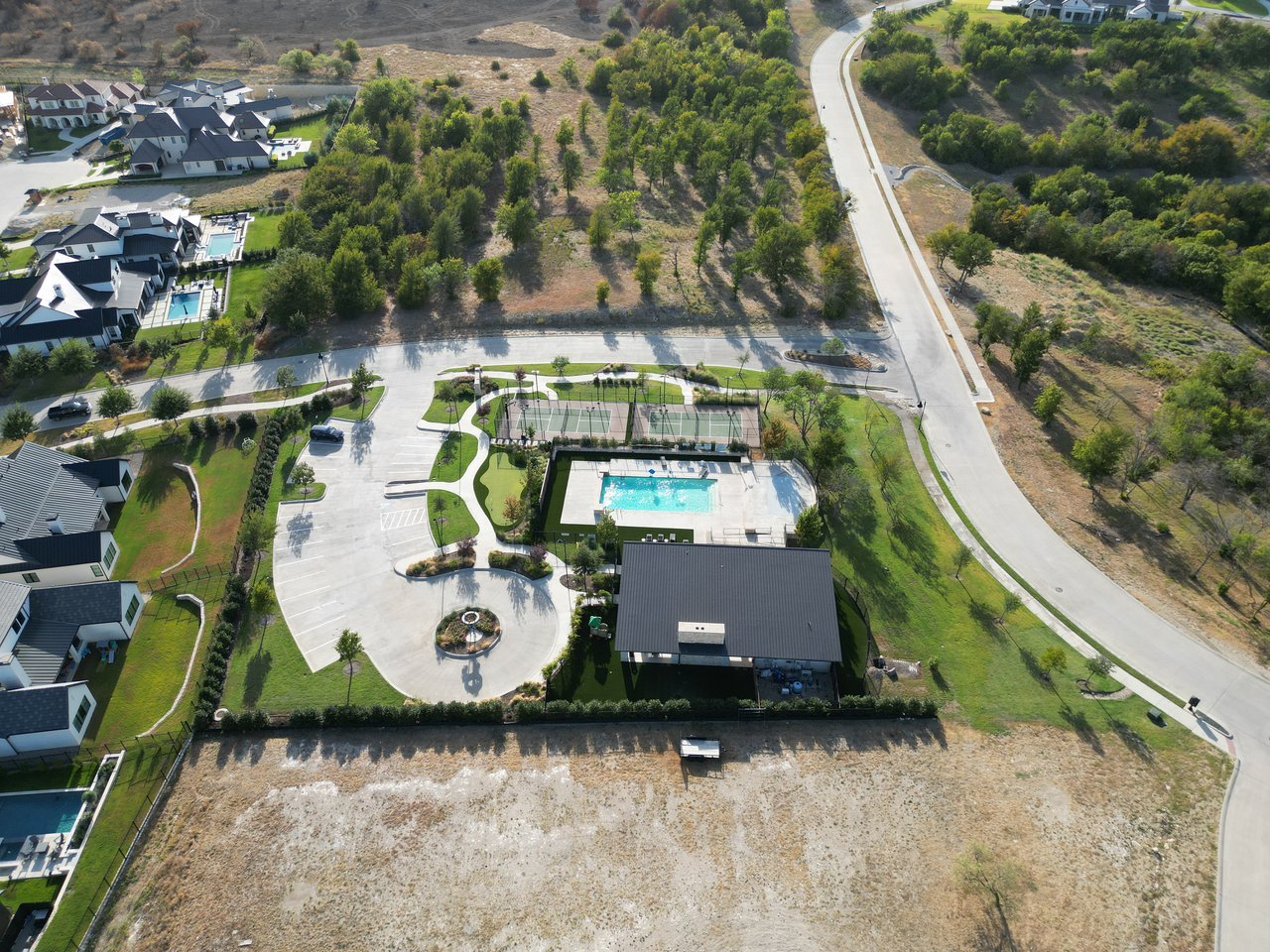 Montserrat / Montrachet
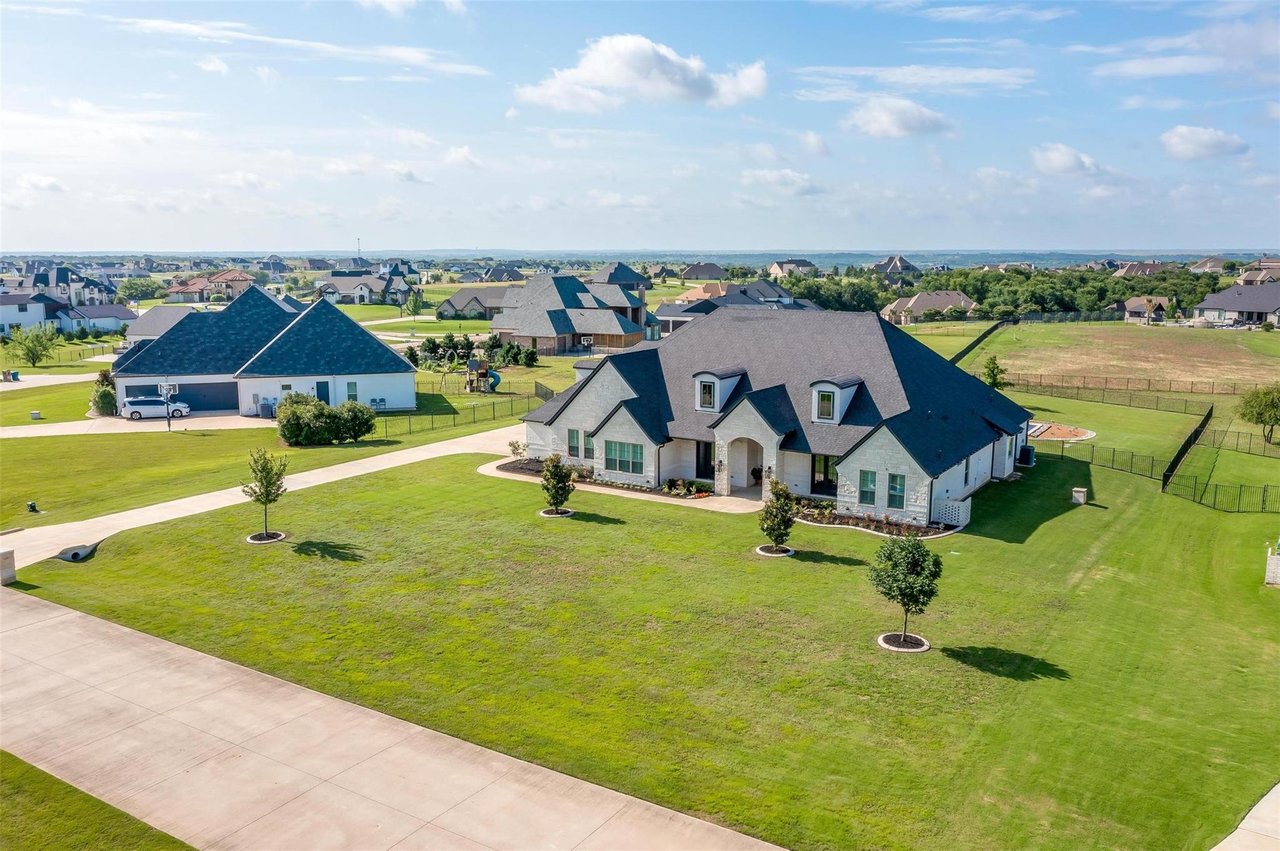 Bella Flora
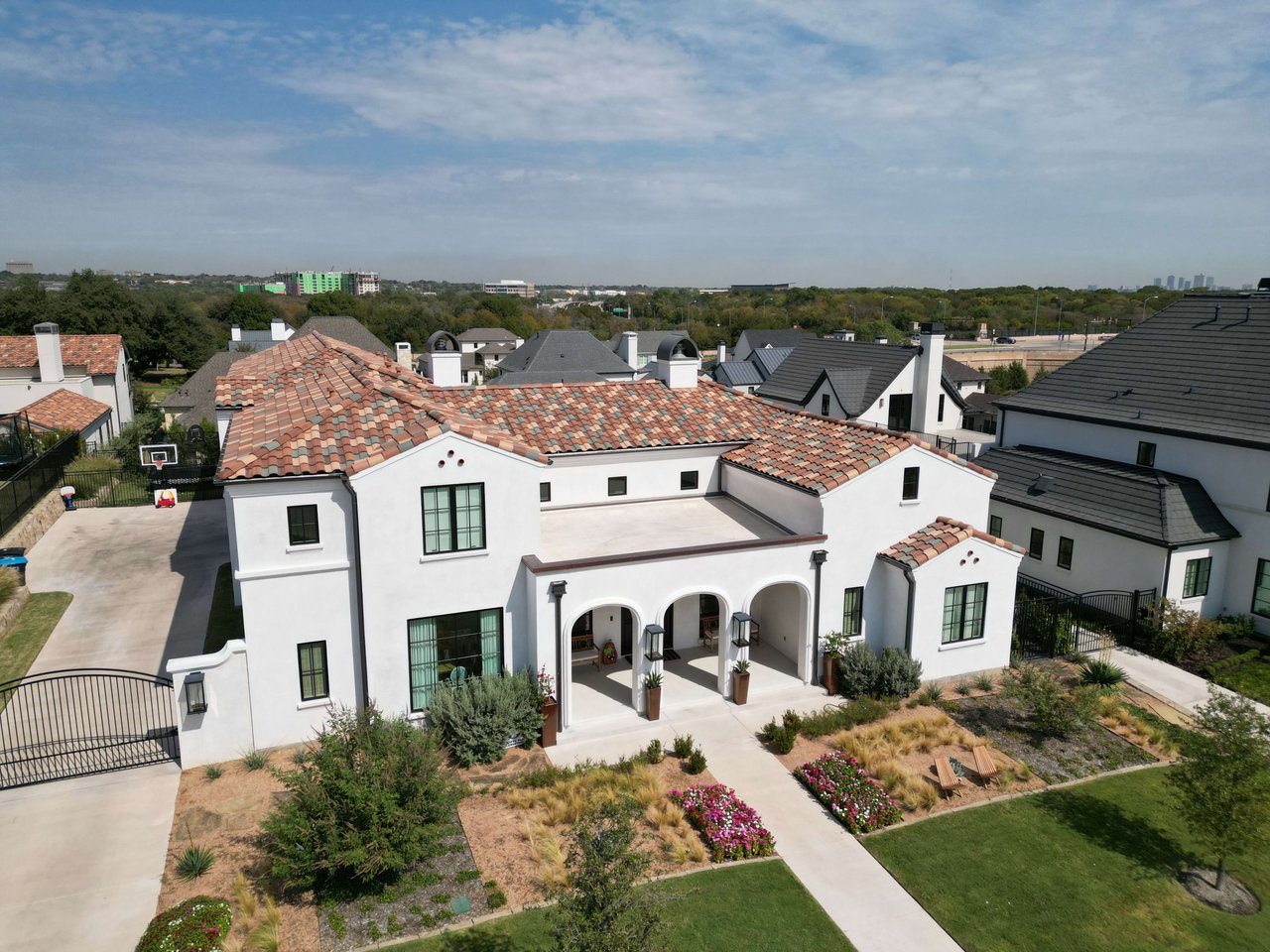 Edwards Ranch Riverhills
 Tavolo Park
 Ryan Place
 Fairmount
 Ridglea
 Ridglea North
 Ridgmar
 Westover Hills
Rivercrest Bluffs & River District
Westover Hills
Rivercrest Bluffs & River District
 Rivercrest, Monticello & North Hi Mount
 Mira Vista
Overton Park
Overton Woods
Westcliff
Arlington Heights
Benbrook
Ventana
Downtown
Linwood
Eagle Mountain & Marine Creek
Beltmill & Watersbend
Heritage & Alliance
Presidio & Tehama Ridge
Wedgwood
North Richland Hills
Hurst
Euless
Bedford
Grapevine
Westlake
Keller
Southlake
Colleyville
Arlington
Burleson
Crowley
Mansfield
Kennedale
Aledo
Weatherford
Azle
Granbury
Springtown
Cleburne
Joshua
Godley
Alvarado
Ponder
Krum
Waxahachie
Midlothian
Poolville
Decatur
Justin
Mira Vista
Overton Park
Overton Woods
Westcliff
Arlington Heights
Benbrook
Ventana
Downtown
Linwood
Eagle Mountain & Marine Creek
Beltmill & Watersbend
Heritage & Alliance
Presidio & Tehama Ridge
Wedgwood
North Richland Hills
Hurst
Euless
Bedford
Grapevine
Westlake
Keller
Southlake
Colleyville
Arlington
Burleson
Crowley
Mansfield
Kennedale
Aledo
Weatherford
Azle
Granbury
Springtown
Cleburne
Joshua
Godley
Alvarado
Ponder
Krum
Waxahachie
Midlothian
Poolville
Decatur
Justin
Stay up to date on the latest real estate trends.
Seller Resources
Your old days on market follow you until you've been gone 30 days — then they vanish completely. 16,465 relisted DFW houses measured.

Home Improvement
About 9% of your price almost regardless of neighborhood — half to all of what one costs to build. And they sell eight days faster.
Buyer Resources
On a new build the listed tax is the vacant lot's bill, and it roughly quadruples in year two — about $526 a month on a $450,000 house.
Buyer Resources
Owned panels add about 3%. Leased panels add nothing — and a listing that doesn't say which gets priced like a lease.
Seller Resources
Your twenty acres are not worth ten times your neighbor's two. Per-acre price falls about a quarter every time a tract doubles.
Owner Resources
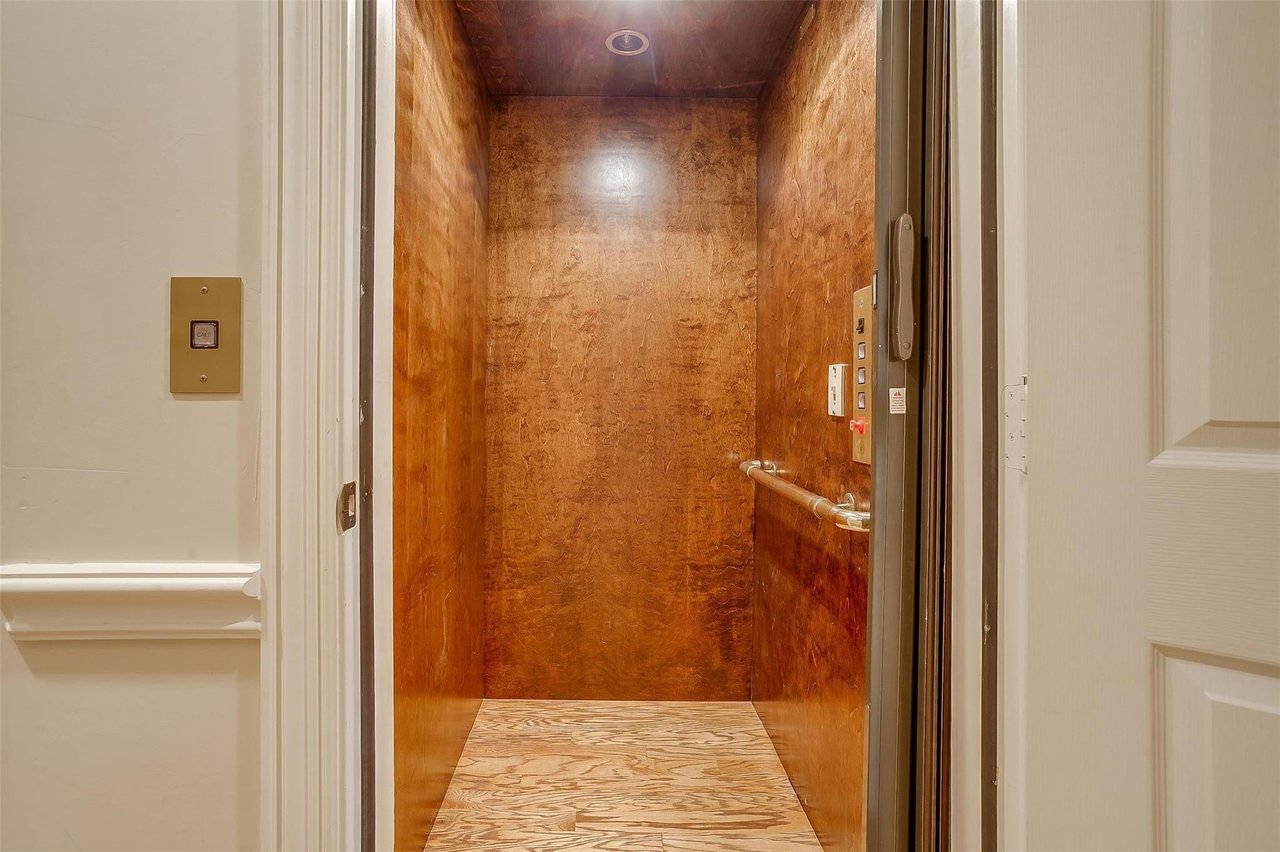
I listed one in North Richland Hills that sold in nine days at 99% of asking. The elevator wasn't why — and 121 sales out of 89,302 show why not.

Buyer Resources
Across 40,703 sales in 19 markets, houses on subdivision lots are down about 1% a year while houses on an acre or more are up about 1%. The pattern holds inside the sa… Read more

Owner Resources
What 33,000 Fort Worth Sales Say About Fixing Up Before You List

Owner Resources
Nothing on this list is automatic. One of these took effect nine months ago and almost nobody has filed.
I've trained three appraisers in this market, and every figure on this blog comes from closed sales I pull and model myself. The same analysis, applied to one address.