What Texas Veterans Are Owed on a House
Owner Resources

Owner Resources
I did not serve. I want to say that first, because what follows is a list of things veterans have earned, and I have no standing to claim any of it.
What I have is a house full of people who did. My wife served in the Air Force. My father-in-law spent more than thirty years in the Marine Corps before he retired a few years ago. My father was an Army Ranger. So I have spent a lot of my life around people who don’t talk about their service much and don’t ask for anything — and I have watched more than one of them leave real money on the table because nobody told them it was there.
Including, for a while, my own household.
When my wife and I first met, she carried a disability rating in the neighborhood of 90%. I called the Tarrant Appraisal District to ask whether it was worth adding her rating to our exemptions. The woman on the phone told me no, not really — you don’t save much unless you’re 100% disabled.
So I dropped it. I am a licensed broker and a Certified Residential Appraiser. Property tax is literally part of my work. And one general answer to one general question was enough to make me stop looking.
Here is what was actually true. At that rating she qualified for a $12,000 exemption off assessed value — which on a typical Fort Worth house is a couple hundred dollars a year, so the woman on the phone wasn’t lying to me. It genuinely isn’t much. But a couple hundred dollars a year is not zero, it compounds over the years you don’t claim it, and that $12,000 doesn’t even have to sit on your homestead — more on that below.
And the bigger thing: I asked the wrong question, and got a correct answer to it. The right question wasn’t is 90% worth filing for. It was what is the path from 90% to a total exemption — because there is one, it’s called individual unemployability, and it is not a rating. It’s a status. Nobody at a county phone number is going to raise it with you, because it isn’t their job to know your VA file.
That’s the thing about these benefits. They are not one benefit. They are a stack — federal and state, rating-based and age-based, homestead and non-homestead, some with five-year lookbacks and some with two — and no single office can see the whole stack. Your appraisal district knows exemptions. The VA knows entitlement. Your lender knows the loan. Nobody is assembling it for you.
So this article is my attempt to put the stack in one place. Not a thank-you-for-your-service post — a list of specific, dollar-denominated benefits available to Texas veterans who own, are buying, or are selling a home, including a brand-new one that took effect nine months ago that almost nobody has filed for.
I’m a licensed Texas broker and a Certified Residential Appraiser. The property tax and appraisal parts of this are directly my job. Where something is outside my lane, I’ll say so and point you to who does know.
Every Texas property tax exemption requires an application. The VA doesn’t tell your appraisal district anything. Your appraisal district doesn’t go looking. If you don’t file, you don’t get it, no matter how obviously you qualify.
The general deadline is April 30. The forms are free. Most of them are one page.
I’m putting this first because it is the single most common way veterans lose this money, and because the rest of the article is useless if you skip it.
Texas voters approved Proposition 7 on November 4, 2025 — by 86% — and it created a new section of the Tax Code, § 11.136, effective January 1, 2026.
Here is what it does. Before this, the unremarried surviving spouse of a disabled veteran got a total homestead exemption only if the veteran had been rated 100% disabled or individually unemployable at death. A great many veterans die of conditions that federal law presumes to be service-connected — the burn pit and Agent Orange presumptives under the PACT Act — without ever having carried that rating while alive.
Section 11.136 closes that gap. The surviving spouse of a veteran who died as a result of a presumptively service-connected condition now qualifies for a total exemption on the residence homestead, regardless of the rating the veteran held.
The legislature estimated roughly 3,000 Texas households qualify. The law is nine months old. If you are one of them, or you know one of them, this is the paragraph to act on — and unlike some of the others, this exemption applies to the entire tax year in which you qualify rather than being prorated from the date you file.
The exemption ends on remarriage. If you move, it follows you as a fixed dollar amount — the amount you received in your last year at the old house — and the chief appraiser issues a written certificate to make that happen.
Tax Code § 11.131. If the VA pays you at the 100% rate and rates you either 100% disabled or individually unemployable, your residence homestead is exempt from the total appraised value — school, city, county, hospital district, college district, all of it. Not a reduction. Zero.
This is the benefit people are surprised by. Individual unemployability matters enormously here: a veteran rated at 90% schedular but paid at the 100% rate through TDIU generally qualifies. If your award letter and your rating letter say different things, take both to your appraisal district and make them read the actual language.
Two mechanical notes. This exemption prorates — if you qualify partway through a year, it applies from the date you qualify, and if you’ve already paid, you get a refund. And it does not automatically follow you to a new house; you re-establish it on the new homestead.
Tax Code § 11.22, for veterans rated below 100%:
Two things about this section are widely missed, and both are worth money.
First, the age-65 provision. A veteran who is 65 or older gets the full $12,000 with a rating of only 10%. Not 70%. Ten. The same is true for a veteran who is totally blind in one or both eyes, or who has lost the use of one or more limbs. Veterans sitting at the $5,000 tier turn 65 and never go back and re-file, and that is a $7,000 difference in taxable value every year for the rest of their life.
Second — and this is the one I get asked about most — § 11.22 does not have to go on your homestead. The Comptroller states it plainly: the disabled veteran exemption can be applied to any one property the disabled veteran owns. That is different from almost every other exemption in the chapter, and it matters in a specific situation.
If you’re already fully exempt under § 11.131, your homestead is at zero. A $12,000 exemption applied to a zero is worth nothing. If you own a rental, a lot, a lake place — that $12,000 has somewhere useful to go.
Two honest limits. It’s one property, not two, and it must be the same property for every taxing unit. And while the Texas Veterans Portal states that a 100% veteran may place the § 11.22 exemption on a different property, I could not find a Comptroller or Attorney General opinion squarely addressing that combination, and administration varies by county. Ask your appraisal district in writing before you count on it. Get the answer in writing too.
Tax Code § 11.132. If a charitable organization donated your homestead — at no cost, or where what you contributed was 50% or less of the market value — and you’re rated below 100%, you get an exemption equal to a percentage of value matching your disability rating. A 70% rating exempts 70% of the value.
This is the paragraph I most want veterans to read.
Under Tax Code § 11.439, a veteran may file a late application for the § 11.131, § 11.132 or § 11.22 exemption up to five years after the delinquency date. If it’s approved, the chief appraiser notifies the collectors within thirty days, the roll is corrected, and taxes you already paid on the exempted portion come back to you — along with the corresponding penalties and interest.
Now connect that to how the VA works. Ratings carry an effective date, and that date is frequently months or years before the decision letter arrives. A veteran whose rating comes through this year, retroactive to three years ago, may be able to reach back and recover taxes for those years.
When you file, put the page showing the effective date on top. Appraisal districts differ in how they handle retroactive dates, and the ones that handle it well are the ones that can see it immediately.
This is the part of my own story that isn’t finished. Those years we didn’t file because I took one phone call at face value — some of them may still be inside the window. I am going to go find out, and if you’ve been waved off the way I was, you should too.
One serious asymmetry. That five-year window applies to the veteran. It expressly does not apply to a surviving spouse, who falls back to the general two-year rule. If you are a surviving spouse who has just learned you qualify — particularly under the new § 11.136 — the clock you’re on is shorter than the one you may have been told about. File now.
Most veterans know the headline: no down payment, no mortgage insurance. Both are true and both are bigger than they sound. The absence of mortgage insurance is permanent — there’s no monthly MI and no upfront premium, ever, which is the structural difference between a VA loan and an FHA loan and it compounds over the life of the loan.
Three things worth knowing beyond that.
The funding fee, and who doesn’t pay it. For a purchase with less than 5% down, the fee is 2.15% of the loan on first use and 3.3% on subsequent use. Put 5% down and it drops to 1.5%; 10% down and it’s 1.25%.
You are exempt from the funding fee entirely if you’re receiving VA compensation for a service-connected disability, if you’re eligible for it but receiving retirement or active-duty pay instead, if you’re a surviving spouse receiving Dependency and Indemnity Compensation, or if you have a proposed or memorandum rating before closing from a pre-discharge claim. On a $500,000 loan that exemption is worth about $10,750.
One correction to something repeated constantly online: the Purple Heart exemption, as the VA writes it, applies to an active-duty service member who documents the award before closing. A separated veteran with a Purple Heart needs to qualify on one of the other grounds, usually service-connected compensation. Ask your lender rather than assuming.
And if your rating comes through after you closed and paid the fee, ask about a refund. It’s keyed to the effective date of the rating, and it is not something anyone will volunteer.
There is no loan limit on full entitlement. County loan limits were eliminated for full-entitlement borrowers effective January 1, 2020. If you have full entitlement, the VA does not cap your loan amount — your lender’s underwriting and the appraisal do. Limits still apply if you have partial entitlement, which brings us to the part of this article that is worth the most money.
If you bought with a VA loan when rates were low, you are sitting on an asset most sellers don’t have: your loan is assumable. A buyer can take over your note at your rate.
Against today’s rates, that is frequently the single most valuable feature of the listing, and I see it go unmentioned constantly. Sellers list the house and never say a word about the 2.75% attached to it.
But there is a term you need before you do this, and getting it wrong is expensive in a way that doesn’t show up for years.
Your VA entitlement is what makes the zero-down loan possible, and it is currently attached to your loan. Two different things can happen when somebody assumes it.
If an eligible veteran with sufficient entitlement assumes your loan, intends to occupy the home, and completes a Substitution of Entitlement at the time of the assumption — their entitlement replaces yours, and yours is restored. You walk away with your benefit intact and available for the next house.
If a non-veteran assumes your loan, you are released from liability for the debt — but your entitlement stays tied to that loan until it is paid in full. The VA now requires you to sign a form acknowledging exactly this, precisely because so many veterans didn’t understand it. The form says it in so many words: your entitlement will not be restored unless the assumer is an eligible veteran who completes an SOE.
That does not mean you can never use a VA loan again. You can, on your remaining — sometimes called second-tier or bonus — entitlement. It means your zero-down ceiling on the next house is lower, and you should know that number before you sign anything, not after.
The practical point for a seller: Substitution of Entitlement is not retroactive. It happens at the assumption or it doesn’t happen. If two buyers are otherwise comparable and one is a veteran who will occupy the home, that buyer is worth materially more to you than the offer price suggests.
I’d rather you hear these from me than discover them at week six.
None of that makes assumability less valuable. It makes it a feature that has to be marketed deliberately and to the right buyer, which is a different job than putting a sign in the yard.
A VA appraisal is not a conventional appraisal with a different cover page. Four differences matter to you.
The appraiser is assigned by the VA from its fee panel. Your lender does not pick them.
Minimum Property Requirements are conditions of closing, not observations. A conventional appraiser notes that something needs work. A VA appraiser conditions the loan on it being fixed. Worth knowing: the VA revised its MPR chapter effective May 1, 2026 — among other changes, the radon testing requirement was eliminated, and the standards for homes built before and after 1978 were revised. Several widely circulated MPR checklists are now out of date. If someone hands you a list, check its date.
Tidewater. This has no conventional equivalent and it is genuinely in your favor. If the VA appraiser’s developing opinion of value is coming in below the contract price, they are required to say so before finalizing the report, and the lender gets a short window to submit additional closed sales. It exists to catch the problem while it can still be fixed rather than after. If your lender mentions Tidewater, the correct response is to get your agent supplying comparable sales that same day, not to panic.
The escape clause is mandatory. Federal regulation requires specific language in every VA purchase contract signed before the veteran receives the Notice of Value: that the purchaser will not forfeit earnest money or be obligated to complete the purchase if the contract price exceeds the reasonable value established by the VA. In Texas this rides on the TREC VA addendum. Confirm it is actually executed. Don’t assume.
The Texas Veterans Land Board, run through the General Land Office, offers three loan programs funded by state bond sales rather than tax dollars. Two of them have no federal equivalent at all, which is why most veterans have never heard of them.
The land loan. The VA will not finance raw land. The VLB will — up to $200,000, thirty-year fixed, minimum 5% down, minimum one acre, land wholly within Texas with legal road access. There’s a catch worth knowing: you can’t have owned the property in the previous three years, and no value is credited for existing improvements. It’s a raw-land program.
The home improvement loan. Up to $50,000, no down payment, for alterations and repairs. And here is the part that makes it worth a phone call: veterans with a VA service-connected disability rating of 30% or more get a discounted interest rate — half a percentage point below the base rate.
The home loan, up to the conforming limit, with the same disability rate discount.
Eligibility adds a Texas residency requirement and includes Texas National Guard members. Note that the VLB does not refinance. And the rates reset weekly, so anything I print here would be wrong by the time you read it — call the GLO at 1-800-252-8387 and ask for the current base and discounted rate the day you’re deciding.
The tax deferral. Texas lets a disabled veteran — among others — defer property taxes on a homestead by filing an affidavit with the chief appraiser. Interest accrues at 5% a year instead of the standard delinquency rate, and no penalty accrues during the deferral.
It is a real relief valve for someone in a hard year. It is also not forgiveness. Deferred taxes plus interest accrue as a lien, and they come due when the property is sold. I have seen sellers find a five-figure payoff on their settlement statement that they had genuinely forgotten about. If you have a deferral on file, tell your agent at the listing appointment, not at the title company.
Moving. If you sell and buy, your exemption does not travel with you automatically. You re-establish it on the new homestead. And for a surviving spouse, moving converts a total exemption into a fixed dollar amount — whatever you received in your last year at the old house. On a more expensive home, that can be a much smaller benefit than you had. It is worth running that math before you decide to move, not after.
If you read nothing else:
I can help with the parts that are actually mine: what your house is worth and why, whether an assessed value is worth protesting, how to market an assumable loan, and what a VA appraisal is going to ask of a specific property before you go under contract on it.
For the exemption filings themselves, your county appraisal district will walk you through the forms for free and I’d rather you use them than pay anyone. For anything involving your rating, your entitlement amount, or a claim, a Veterans Service Officer at the Texas Veterans Commission or your county is the right person, and also free.
If you’re somewhere in the middle — trying to decide whether to sell, whether to keep the low rate, whether the numbers work — that’s a conversation I’m glad to have with no expectation attached.
Call or text (682) 207-4310, or send me a note.
General information, not legal or tax advice, and not a substitute for your appraisal district, your lender, or a Veterans Service Officer. Exemption amounts, VA fees and program rates change; verify anything you’re about to rely on. Every figure here was current when written.
Texas property tax exemptions
The 2025 constitutional amendments
VA loans, entitlement and assumptions
VA appraisal
Texas Veterans Land Board
Terrence Bilodeau is a Texas licensed broker (TREC #0686157) with The Bilodeau Group at Compass RE TX and a Texas Certified Residential Appraiser (TALCB #1360232). This article is general information, not legal or tax advice.
Stay up to date on the latest real estate trends.
Owner Resources
Nothing on this list is automatic. One of these took effect nine months ago and almost nobody has filed.
New Construction
Your escrow is about to jump, your warranty is shorter than you think, and the yard has something to tell you.
New Construction
The new-home incentives are real. So are the twelve paragraphs nobody reads.
Seller Resources
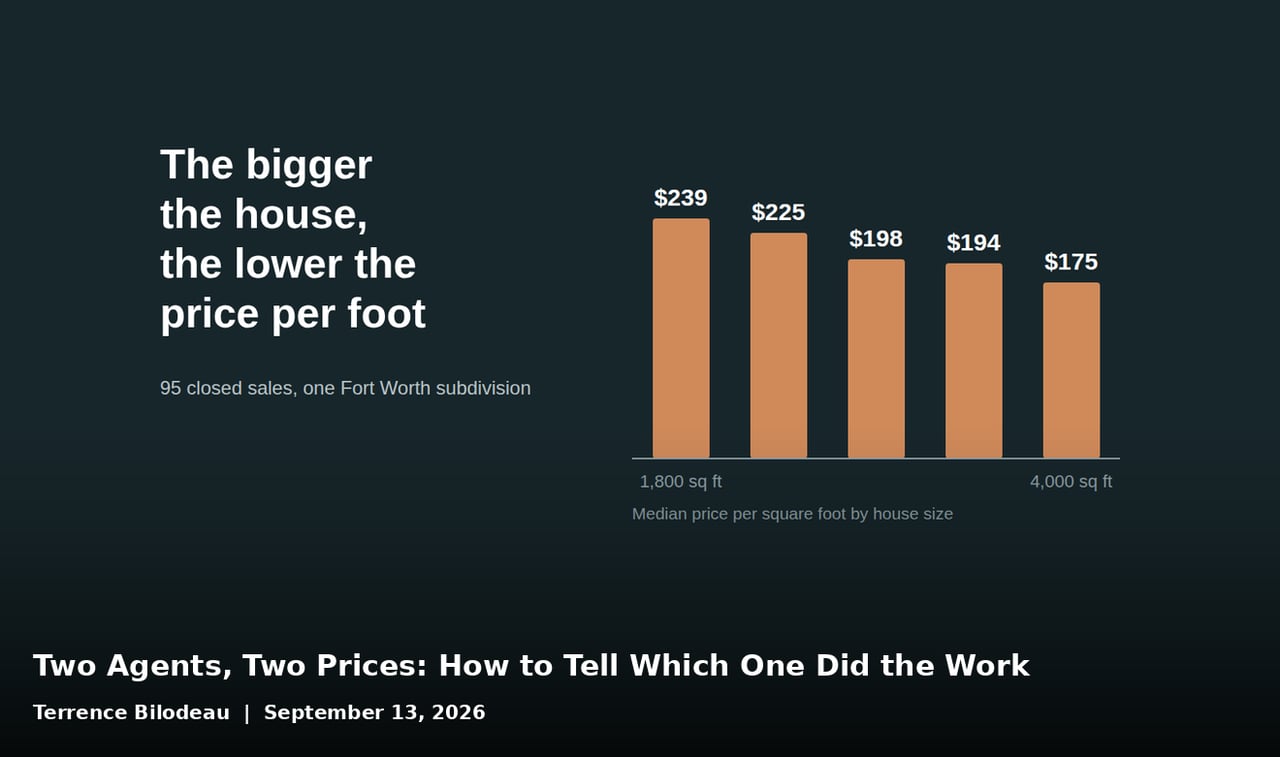
Why price per square foot misleads in a predictable direction, what a careful pricing analysis actually includes, and the four questions that separate them.

Growth
An appraiser's read on what the growth actually is, what the 2025 property tax changes really did, and what to check before you buy here.

Buyer Resources
The documents that tell you where the HOA dues are headed — and the window you have to read them.
I've trained three other appraisers in my market and also own and manage rental property in Tarrant and Dallas counties which keeps me in the know on home ownership costs, contributory value for improvements, and deriving values using the income approach for investment purposes.