Bella Flora
Explore Bella Flora luxury homes and market insights with a Fort Worth broker and Certified Residential Appraiser experienced in the community.
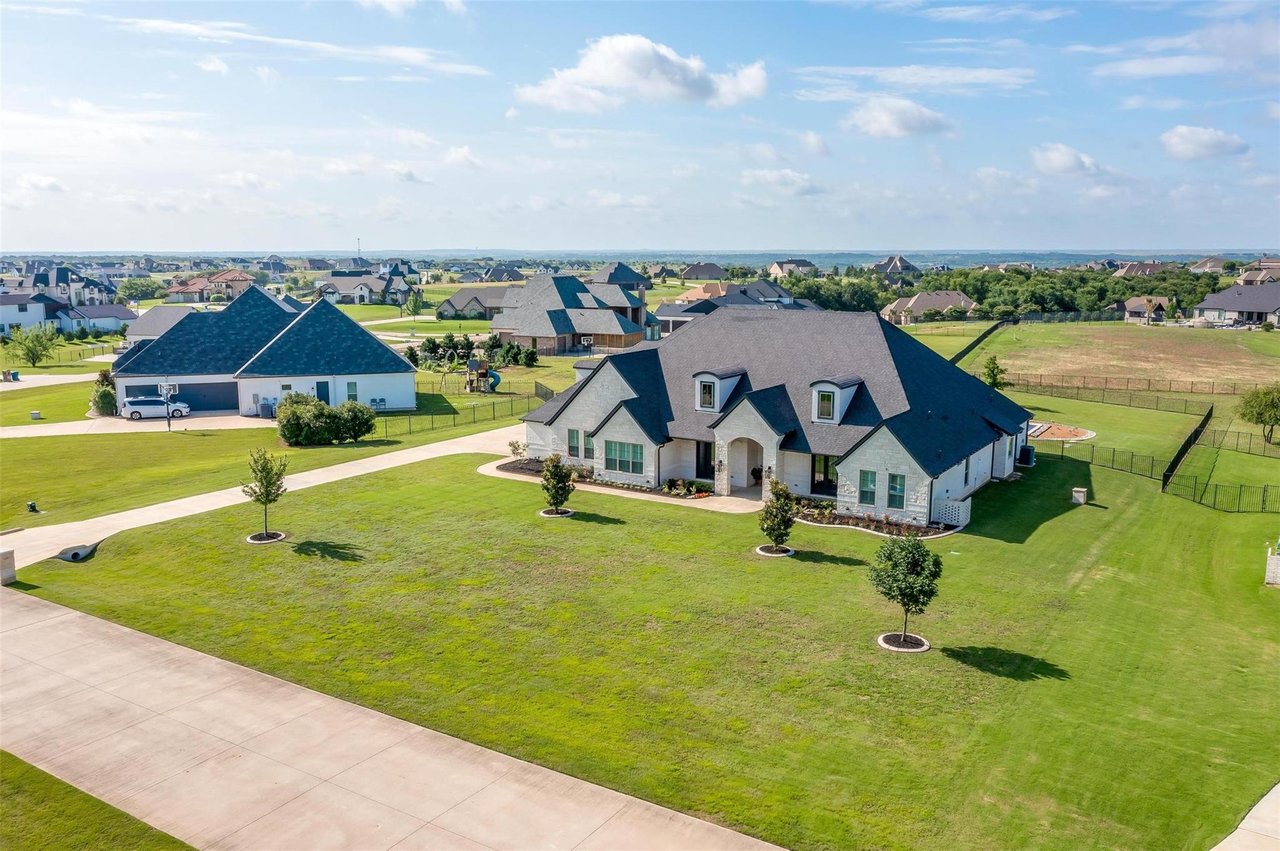
Explore Bella Flora luxury homes and market insights with a Fort Worth broker and Certified Residential Appraiser experienced in the community.
Bella Flora is a gated luxury community on the far west side of Fort Worth, where the city gives way to the rolling country that runs toward Aledo and Parker County. Custom homes on acreage-style lots, mature trees, open views, walking paths, and a genuinely private residential setting — with downtown Fort Worth, the hospital district and the Clearfork and Waterside shopping corridors all still in easy reach.
It appeals to buyers who want space and architectural distinction without trading away access to the city. Buyers looking here often also look at Montserrat and Montrachet closer in, and at Walsh to the northwest — each a different trade between land, gate and drive time. Highway 377 is the main artery out here, with Benbrook, Lake Benbrook and southwest Fort Worth a few minutes east and I-20 close by.
I'm a Fort Worth broker and a Certified Residential Appraiser, and I've represented clients on both sides of the gate here. What follows is the version I'd give a client — including a few things about this neighborhood that don't show up in a listing description.
The first thing to understand about Bella Flora is that the name covers more than one place.
There's the original guarded section — the older, interior streets, behind a manned gate. There's Bella Ranch to the east, gated but not guarded, developed later and finished much more recently. And there's Bella Crossing, a smaller group that only turns up in a search if you also look under Bella Xing.
In the MLS, most of them carry the same subdivision name. Which means every automated valuation you'll see for “Bella Flora” — every Zestimate, every per-square-foot average — quietly blends all three together.
They shouldn't be blended, and the difference is not subtle. Looking at the two years of sales ending September 2026, the guarded section and the sections east of it closed at almost exactly the same median price — and for that money, the guarded side delivered roughly seven hundred more square feet of house.
Median closing price ran about $1.06 million behind the guard and $1.04 million east of it. Median size, 4,378 square feet versus 3,681. The per-foot figures diverge accordingly, $239 against $283 — but much of that spread is newer construction on the east side rather than a location premium, and it narrows once you compare resale to resale.
The homes behind the guard are older, larger, and in my experience built to a heavier standard. The homes east of it are newer, with current finishes and floor plans — and if you're buying one of the newest, the contract and first-year pieces I've written apply here the same as anywhere. Both are good; they're simply not the same purchase, and the subdivision field won't tell you which one you're looking at.
Bella Flora is a custom and semi-custom market, which means the spread between the best and the weakest construction is wider than it would be in a volume-builder neighborhood — and none of that spread is visible in a price per square foot.
Homes here vary in age, design, build quality and level of improvement. Many offer generous living areas, serious outdoor entertaining space, pools, and lots of an acre or more. When I'm comparing two properties in this community, the things that actually move value are:
Bella Flora is generally known as an Aledo ISD community, and most of it is — including nearly all of the guarded section.
But not all of it. Across the listings I reviewed in this area over the past two years, a meaningful share — roughly four in ten — were assigned to Fort Worth ISD rather than Aledo, almost entirely on the eastern side. At least two streets here have homes on both sides of the line.
I mention it because school assignment is one of the main reasons buyers look this direction, and it is not something the subdivision name or the street name will settle for you. Verify the attendance zone for the specific address with the district before you write an offer. That's ordinary good practice anywhere; here it's essential.
A word on market conditions, since it's the question every seller opens with. Bella Flora is small enough that I won't pretend to a precise trend — 23 closed sales over two years is too thin to separate a real move from noise. What the numbers do show is a per-foot figure drifting upward rather than down, and nothing in the data pointing the other way.
The wider picture is the useful one here. Of the eighteen Fort Worth neighborhoods I measure, none shows a statistically significant decline in price per square foot, and four are measurably rising. What changed since 2022 is time on market, not value. In a gated community with ten or twelve sales a year, that combination means an optimistic list price doesn't get corrected quickly — it just sits, and the owner usually takes the house off rather than cutting. Getting the number right at the start matters more here than almost anywhere.
Property taxes. The 2025 combined rate on the Aledo ISD parcels I reviewed runs about 1.73% — city, county, hospital district, college district and schools — and, importantly, there is no PID assessment.
That's worth knowing if you're cross-shopping the west side. Several of the master-planned communities out this way financed their roads and utilities through a Public Improvement District, which rides on top of ordinary property taxes for decades. I've also written about what Fort Worth's growth has done to the tax bill more broadly. Walsh, in the same school district twelve miles from here, runs closer to 2.69% once its PID is counted. Nearly a full point — roughly $9,600 a year on a million dollars of assessed value, and it appears in neither sale price. Confirm the current rate for any specific address; rates and exemptions change.
HOA. Dues split along the same line as everything else. The guarded section runs a median of about $2,675 a year; the eastern sections about $700. The difference is essentially the manned gate — roughly $165 a month for a staffed entrance rather than a keypad. Reasonable either way, but I've watched buyers compare a guarded-section home to a Bella Ranch home on monthly payment and never learn that two thousand dollars a year of the gap is the guard.
Utilities are not city utilities. These homes are on private wells and on-site septic. More on that below — it's the biggest practical adjustment for buyers coming from inside Loop 820.
Maintenance and time. An acre of land and four-to-five thousand square feet of house carry real recurring cost: lawn and tree work, a septic maintenance contract if the system is aerobic, well equipment, longer roof and HVAC runs. And the commute is genuine — comfortable to southwest Fort Worth, longer to downtown or the north side at rush hour. Drive it at the hour you'd actually be driving it.
Wells out here are not all the same well. Depth, yield, the age of the pump, the condition of the casing — these vary property to property, sometimes street to street, and a neighbor's good well tells you almost nothing about the one you're buying. I've heard of isolated cases in this general area where a well's production fell off and the owner ended up hauling potable water into a cistern or drilling a second well. Those are the exception. But the cost of being the exception runs into five figures, and the cost of asking in advance is nothing.
Before your option period ends, ask for:
If you're financing with FHA or a VA loan, some of this stops being optional: those programs require a water sample collected by a disinterested third party, coliform absent, nitrate at or below 10 mg/L, lead at or below 15 ppb, the well at least 50 feet from the septic tank and 100 feet from the drain field, and a yield that holds up under sustained draw. Build the lab turnaround into your timeline rather than discovering it in the final week.
For context, Tarrant County sits in the Northern Trinity Groundwater Conservation District: wells drilled after October 1, 2010 must be registered, and a domestic well that can't produce more than 17.36 gallons per minute is exempt from permitting. None of that changes what your well does tomorrow. It's simply the reason to treat a well as an asset with a condition and a lifespan — like a roof, not like a utility connection.
The broader west Fort Worth and Aledo corridor is drawing significant luxury investment. Maverick Golf & Ranch Club — Discovery Land Company with PMB Capital, roughly 1,100 acres and about 500 homes off Aledo Road northwest of Lake Benbrook, with a Tom Fazio course — and Bluejack Ranch, a 914-acre private residential club near Aledo with a Tiger Woods–designed course, developed with Lantern Asset Management and Fort Worth's J.J. Henry.
Both are substantial, and both are close. What they'll ultimately mean for infrastructure, commercial services and values in the neighborhoods around them is honestly still unknown — projects of this kind can lift an area's profile, and they also bring traffic and construction for years. I'd rather tell you it's worth watching than tell you what it will do.
This is the part I'd want a seller here to hear, and it starts with the good news: a home positioned near where comparable sales in its own section are clearing still trades here, and trades close to asking.
The reason positioning matters so much is volume. Bella Flora produces roughly ten to twelve closed sales a year on the guarded side. That's not enough transaction volume for the market to answer an optimistic list price quickly. Over the past two years, more than a third of the listings in this area came off the market without selling, and the median guarded-section seller who did sell closed about seven percent below original list.
Those two numbers describe the same thing: when a home is genuinely distinctive and directly comparable sales are limited, the market takes months to say anything at all. Owners out here have equity and no deadline, so when the answer doesn't come, many would rather take the house off than cut. I walked through how a list price gets set, and how to tell a real pricing analysis from a wishful one, in a piece on two agents and two prices.
What works here instead: comparable sales from your section only, an appraiser's accounting of what the gate, the acreage, the trees and the square footage are actually worth against the newer inventory east of you, and the well and septic paperwork assembled before the first showing. Buyers out here aren't rattled by a well. They're rattled by a seller who can't answer questions about one.
I've closed two residential transactions on Modena Drive, inside the guarded section, and handled an off-market transaction on Dolce Vita Drive on the newer side — so I've worked both halves of this community and seen how differently they behave.
That firsthand experience is most of what makes me useful here. Nearly every question in Bella Flora — which section, which district, what the gate is worth, what the well is worth, what a “comparable” sale actually compares to — is a valuation question wearing a real estate hat. Holding both a broker's license and a Certified Residential Appraiser certification means I can answer it with evidence rather than opinion.
For sellers, that means pricing, preparation and marketing strategy supported by market data rather than hope. For buyers, it means a clear read on construction quality, improvements, land, location and long-term resale before you're committed.
If you're considering buying or selling in Bella Flora, I'd welcome the conversation — and if you're early, that's the right time to have it.
Call or text (682) 207-4310, or send me a note.
Sales figures are medians from NTREIS listings and closed sales for the two years ending September 2026, reported in aggregate. Tax rates, HOA dues and school attendance boundaries change — confirm current figures and assignments for a specific property before relying on them.
Whether buying or selling, get property-specific guidance from a Fort Worth broker and Certified Residential Appraiser.