What a home elevator is actually worth
Owner Resources
Owner Resources
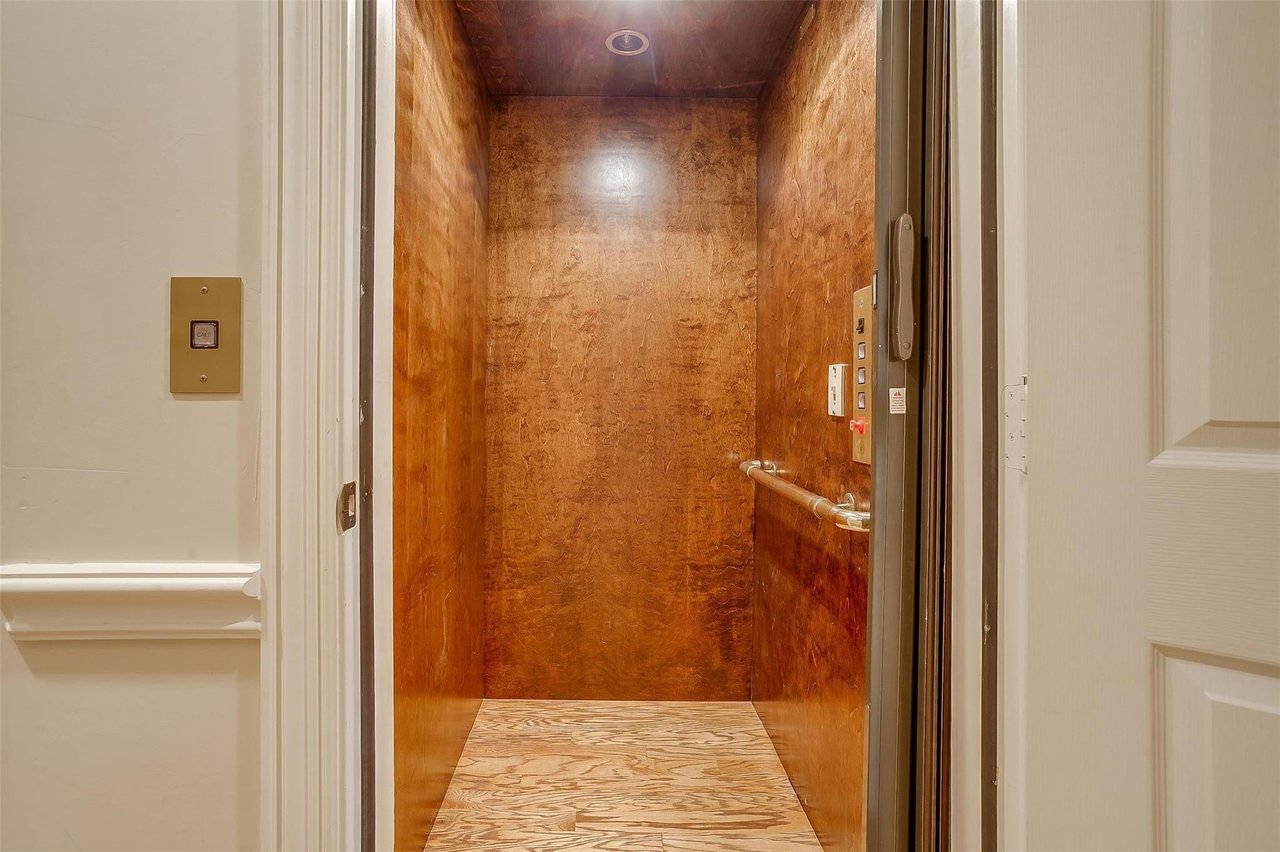
In March 2024 I listed a house on Silverleaf Drive in Forest Glenn West, over in North Richland Hills. Four bedrooms, 4,335 square feet, built in 2007, Birdville ISD. It also had an elevator.
It went under contract in nine days and closed at $857,500 — 99.1% of the original asking price, to a cash buyer.
Here is the part that surprises people: the elevator is not why. I have since run the numbers on every elevator sale I can find in this market, and they say something more useful than "elevators add value."
I pooled 89,302 closed sales of detached single-family homes across Dallas–Fort Worth for the three years ending September 2026. Exactly 121 of them had an elevator — about one in every 738 houses.
Compare those 121 against everything else and they look enormous: about 35% more than houses without one, holding size, lot and age constant. That number is almost entirely an illusion, and you can watch it fall apart as the comparison gets fairer.
What's being compared | Sales | Elevator premium |
Every sale, controlling for city | 89,302 | +35.1% |
Only sales of $700,000 and up | 10,028 | +30.9% |
Only houses of 3,500 sq ft and up | 8,307 | +28.9% |
Both: $700,000+ and 3,500 sq ft+ | 5,542 | +21.4% |
Against neighbors in the same subdivision | 2,826 | +4.5% |
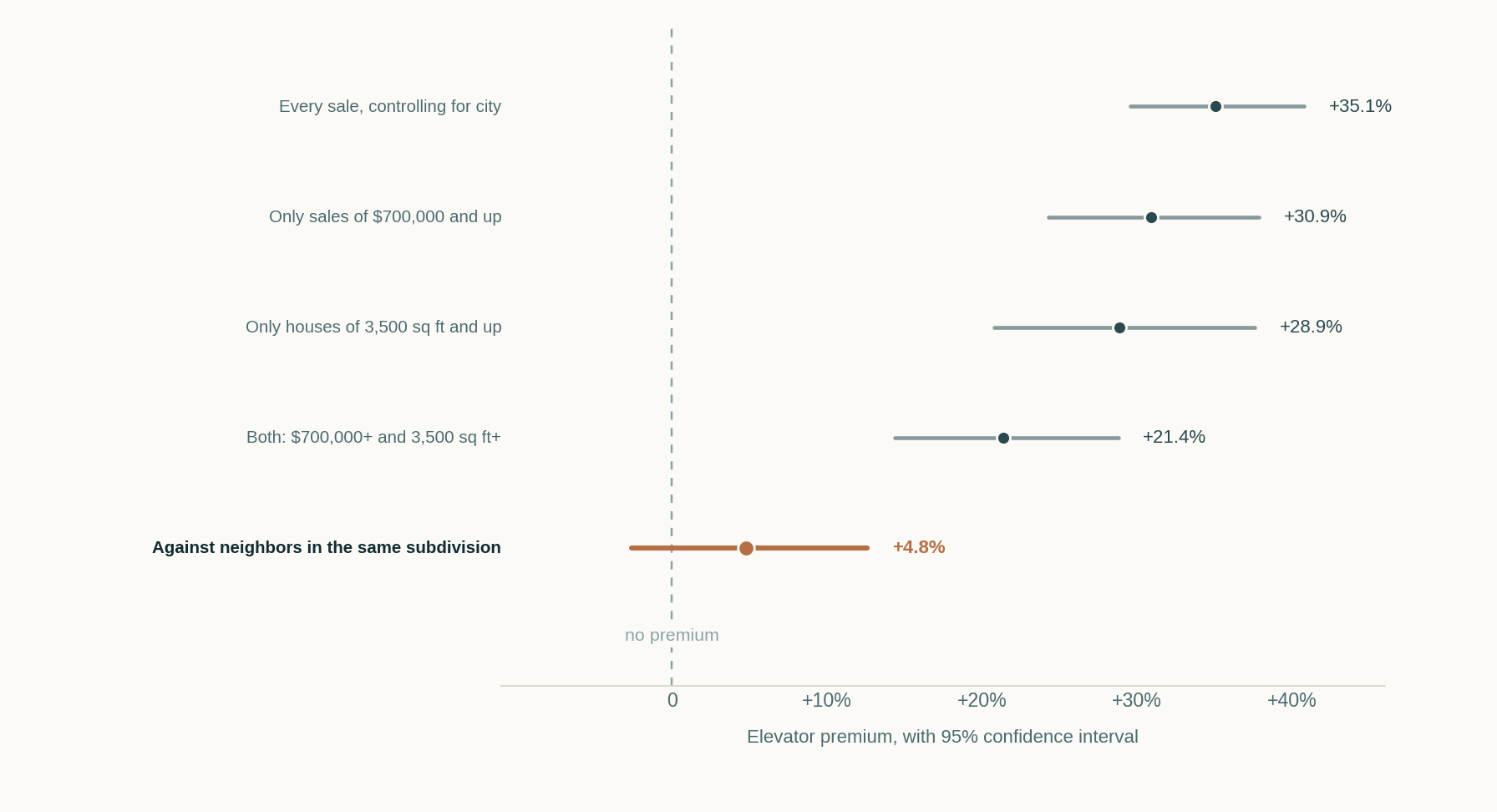
Each row narrows the comparison to houses more like each other, and the premium falls every time. The bar on the last row crosses zero — meaning the honest answer includes “nothing at all.”
Every time I narrow the comparison to houses that are genuinely alike, the premium shrinks. That is the signature of a feature that isn't causing the price — it's marking a house that was going to be expensive anyway. Elevators show up in 0.04% of houses under 3,000 square feet and 18% of houses over 8,000. They're a flag for "very large house," and very large houses cost more for a hundred reasons that have nothing to do with a lift.
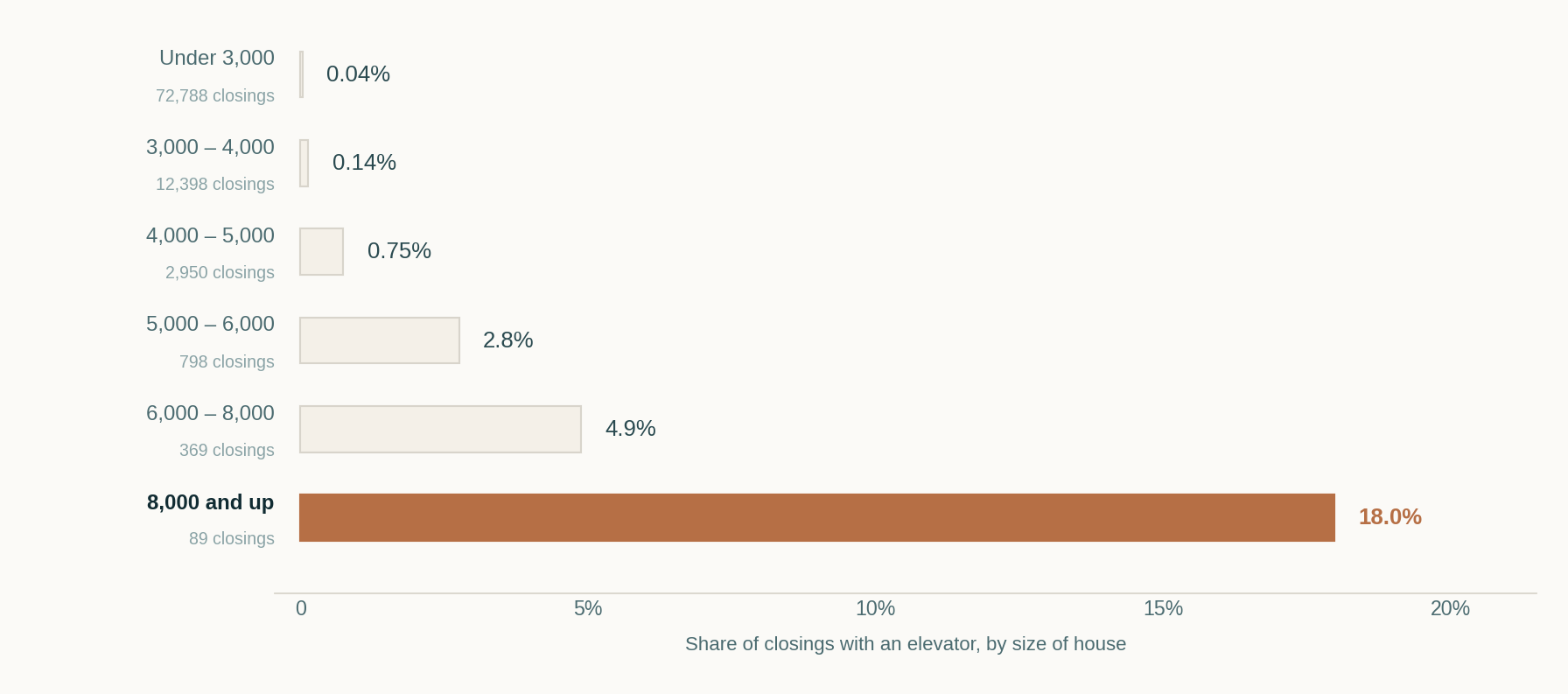
Elevators are a feature of the very largest houses, not of expensive houses generally. That is most of where the illusion comes from.
Compared with its own neighbors, the elevator is worth about 4.5%, and the statistical range around that number runs from slightly negative to about +12%. In other words, the honest answer includes zero.
I wrote the full analysis up on my appraisal practice's site, with the regressions, the robustness tests and the charts: what a home elevator is worth, from the appraiser's side.
The subdivision I sold in is a clean little demonstration, because it happens to contain two elevator homes and seven without. Here is every closed sale in Forest Glenn West in the window:
Street | Closed | Price | Size | Per foot | Elevator |
Silverleaf | Oct 2023 | $648,000 | 3,641 | $178 | — |
Green Valley | Jul 2024 | $669,900 | 3,247 | $206 | — |
Oak Knoll | Oct 2025 | $700,000 | 3,408 | $205 | yes |
Silverleaf | Jun 2024 | $780,000 | 4,242 | $184 | — |
Silverleaf | Nov 2024 | $825,000 | 3,628 | $227 | — |
Fairwest | Apr 2025 | $838,000 | 3,780 | $222 | — |
Silverleaf (my listing) | Apr 2024 | $857,500 | 4,335 | $198 | yes |
Forest Point | Apr 2025 | $899,900 | 4,105 | $219 | — |
Forest Point | Feb 2026 | $942,000 | 4,571 | $206 | — |
The two elevator homes closed at $205 and $198 a foot. The seven without ran $178 to $227, median $206. The elevator houses land squarely in the middle of their own neighborhood. If you were handed this table with the last column covered up, you could not pick them out.
So what did sell my listing in nine days at 99.1% of ask? It was priced against those neighbors rather than against a number somebody wanted the elevator to be worth. Across the wider market, houses over 3,500 square feet with an elevator take a median 48 days to go under contract and close at 94.1% of original list. Nine days and 99.1% is not what happens when you price a feature the market doesn't pay for.
Here is something most buyers don't know and most listings don't say. "Elevator" in the MLS covers at least six different pieces of equipment, and the cheapest and the dearest are more than two to one apart on cost alone.
Type | How it works | Notes |
Hydraulic | A jack pushes the car up; a valve lets fluid back out to lower it | The workhorse. Heaviest loads, smooth ride, needs a small machine space for the pump |
Winding drum | A motor winds steel cable onto a drum, usually overhead | Fewer parts, often no separate machine room. Common in retrofits |
Traction | Ropes over a sheave with a counterweight doing the work | Quiet and efficient. The commercial standard; higher-end in houses |
Chain drive | A chain instead of cable, geared for load | Durable, well suited to wheelchair use |
Pneumatic vacuum | A sealed clear tube; air pressure above the car is reduced and it rises | No pit, no shaft, no machine room. Small car, lower capacity |
Through-the-floor | A platform through an opening cut between two floors | Technically a lift. Cheapest, slowest, smallest — and often listed as an elevator |
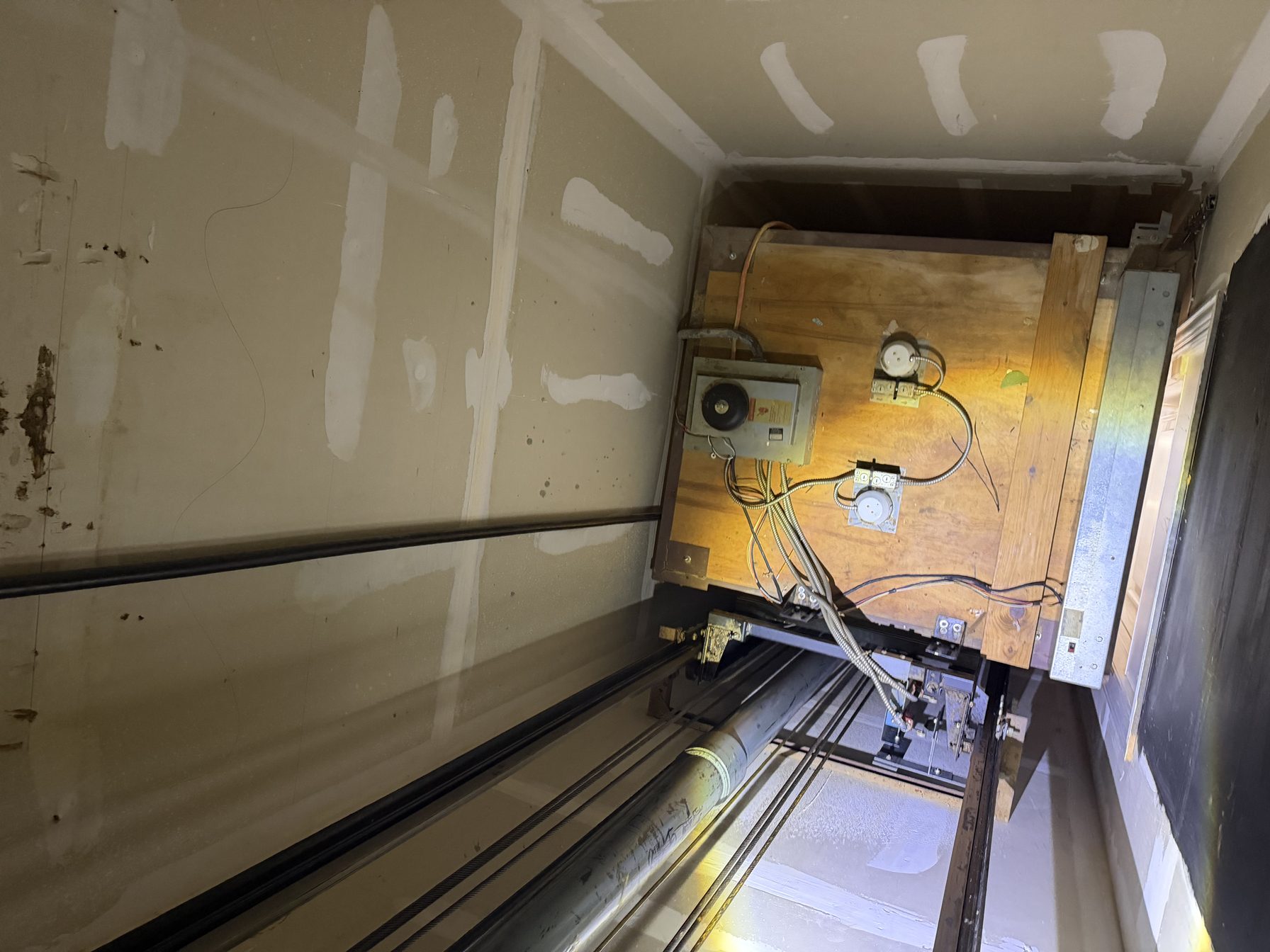
Inside a hydraulic hoistway. The jack and rails run the length of the shaft and the plywood board carries the disconnect and controller. This is the part of an elevator nobody photographs for a listing — and the part that decides what it is worth.
Published installed prices run roughly $30,000–$40,000 for a shaftless through-floor lift, $45,000–$75,000 for a conventional two- or three-stop elevator with a hoistway, and $75,000 and up once you add stops or glass. Retrofitting an existing house costs more than framing one in during construction.
Which is the first practical point of this whole article: if you are buying a house that lists an elevator, find out which of the six it is before you decide what it's worth to you, because a vacuum tube in a stairwell and a three-stop hydraulic cab are not the same purchase.
A residential elevator is a deliberately small machine with its own section of the national safety code. The cab's clear inside area is capped at 15 square feet, and residential drives are published at around 40 feet per minute. A commercial passenger elevator runs several times faster, carries several times the load, and comes with fire service recall, standby power, ADA-compliant dimensions and controls, and a mandatory inspection cycle.
There's also a safety history worth knowing if you're buying an older one. The gap between the hoistway door and an accordion-style car gate used to be wide enough for a small child to be caught in it, and the code tightened: current checklists call for no more than three inches between the hoistway door and the car gate. Equipment installed before that change predates the rule. Ask when it was installed, and ask whether it has been brought up to current standards.
This one genuinely surprised me when I looked it up. Texas regulates elevators under Health and Safety Code Chapter 754, and single-family houses are carved almost entirely out of it. Section 754.0111(b) says the chapter does not apply to an elevator in a single-family dwelling — with one exception. Section 754.0141 requires that equipment installed on or after January 1, 2004 comply with the ASME code and be inspected by a registered elevator inspector once, after installation, with the report given to the owner.
After that, an inspection happens only if the owner asks for one. No annual certificate, no state file, nothing on the wall.
So if you're buying: ask for the installation inspection report and the most recent service invoice. Very often there is neither, and that is normal rather than alarming — but it means you're relying on a specialist's eyes rather than on paperwork. Have the elevator inspected by an elevator company during your option period. A general home inspector will tell you whether it runs. That is a different question from whether it is sound.
Don't price a premium into it. Price the house against genuinely comparable sales and treat the elevator as a feature that widens your buyer pool rather than one that raises your number. The data is clear that buyers in aggregate don't pay much extra for it — but the right buyer, the one who wants that specific house because of it, is out there and is worth finding.
Then market it properly. Photograph it. Say which type it is, how many stops, when it was installed, and when it was last serviced. An elevator described in three specific sentences reads as a maintained system. An elevator that appears only as one word in a feature list reads as a question mark, and question marks get negotiated.
Get it serviced before you list. An inspection report noting a lift that hasn't been touched in eight years turns a feature into a repair request, and repair requests cost more than the service call would have.
Three different situations, and only one of them is about resale.
Building new? The cheap move is the shaft, not the elevator. Stack closets on each floor, framed and structurally ready, wired for it. That costs a fraction of a retrofit, costs nothing to leave as closets, and turns a $75,000 decision into an option you can exercise later or never.
Retrofitting because somebody in the house needs one? Build it and stop thinking about resale. You're buying the ability to stay in your home, which is worth what it's worth to you. Treat anything that comes back at sale as a rebate rather than a return.
Adding one because you think it will pay for itself? This is the case the numbers argue against. The best-supported estimate is somewhere around what it costs, the honest range includes zero, and it takes a genuinely large house for the effect to be measurable at all. Near cost is better than most discretionary improvements do — but it is not a money-maker, and a contractor telling you otherwise is selling you an elevator.
For what it's worth, the 121 elevator sales clustered in Fort Worth (45), Southlake (15), Westlake (13), Arlington (12) and Granbury (8), with a handful each in North Richland Hills, Colleyville and Mansfield. They are a large-house feature, so they follow the large houses.
I'm a Texas broker and a Certified Residential Appraiser, which means when a house has something unusual in it I can tell you what the closed sales actually support rather than what the feature sheet claims. Sometimes that number is smaller than you hoped. It is always better to know it before you price than after.
If you want the full statistical treatment — the confidence intervals, the matched pairs, the robustness checks — it's on my appraisal site: what a home elevator is worth.
Browse active listings in this price range, or call or text (682) 207-4310, or send me a note.
Figures are medians and model results from NTREIS closed sales of detached single-family homes across Dallas–Fort Worth for the three years ending September 2026, reported in aggregate; condominiums and attached product are excluded. With 121 elevator sales, results should be treated as descriptive rather than precise. Installed cost ranges are published figures from elevator manufacturers and installers. Code references are to secondary sources describing ASME A17.1 Section 5.3, and statutory references are to the Texas Health and Safety Code; confirm current code and statute before relying on either. Nothing here is an appraisal or a valuation of any particular property.
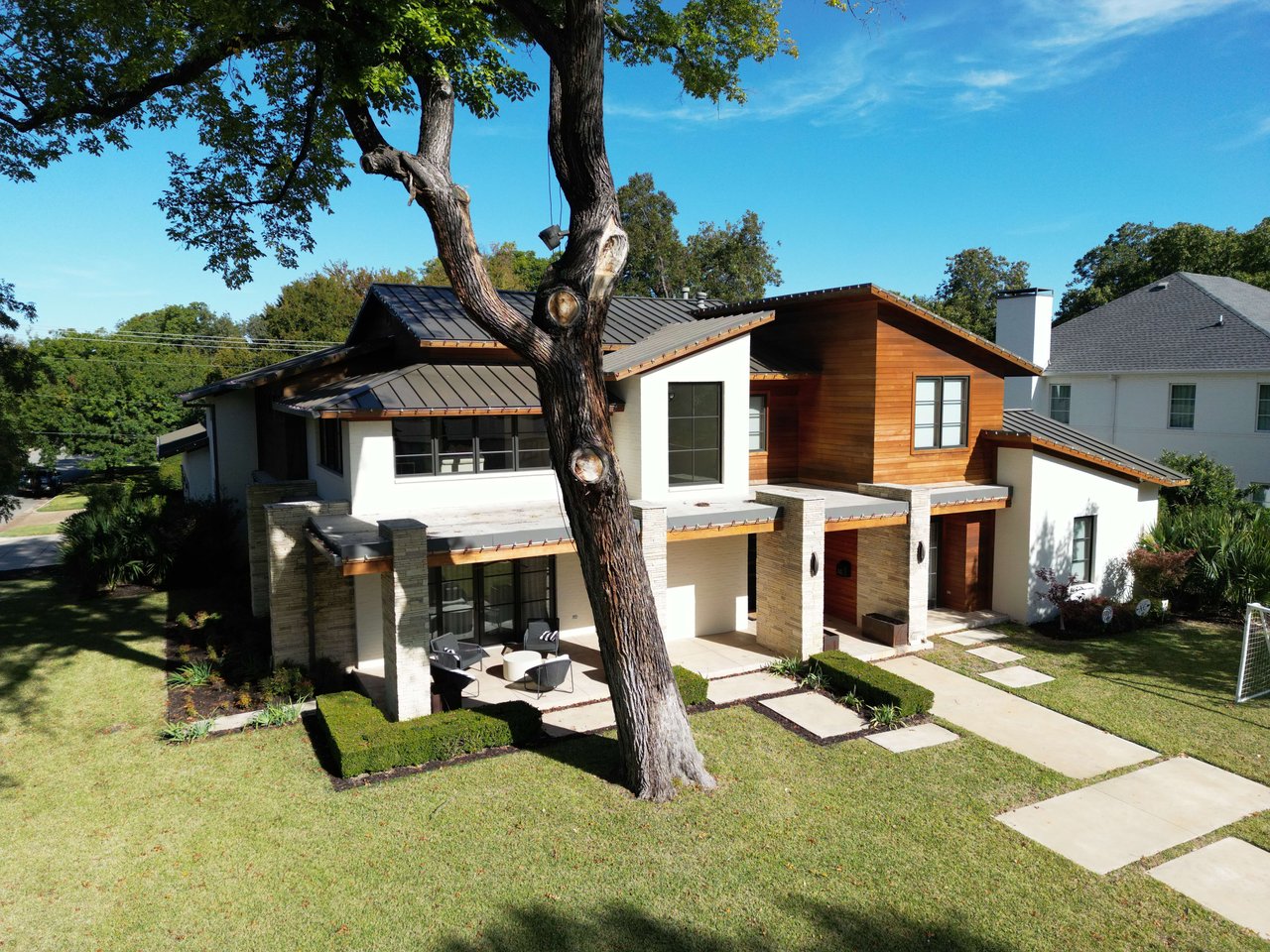 Tanglewood
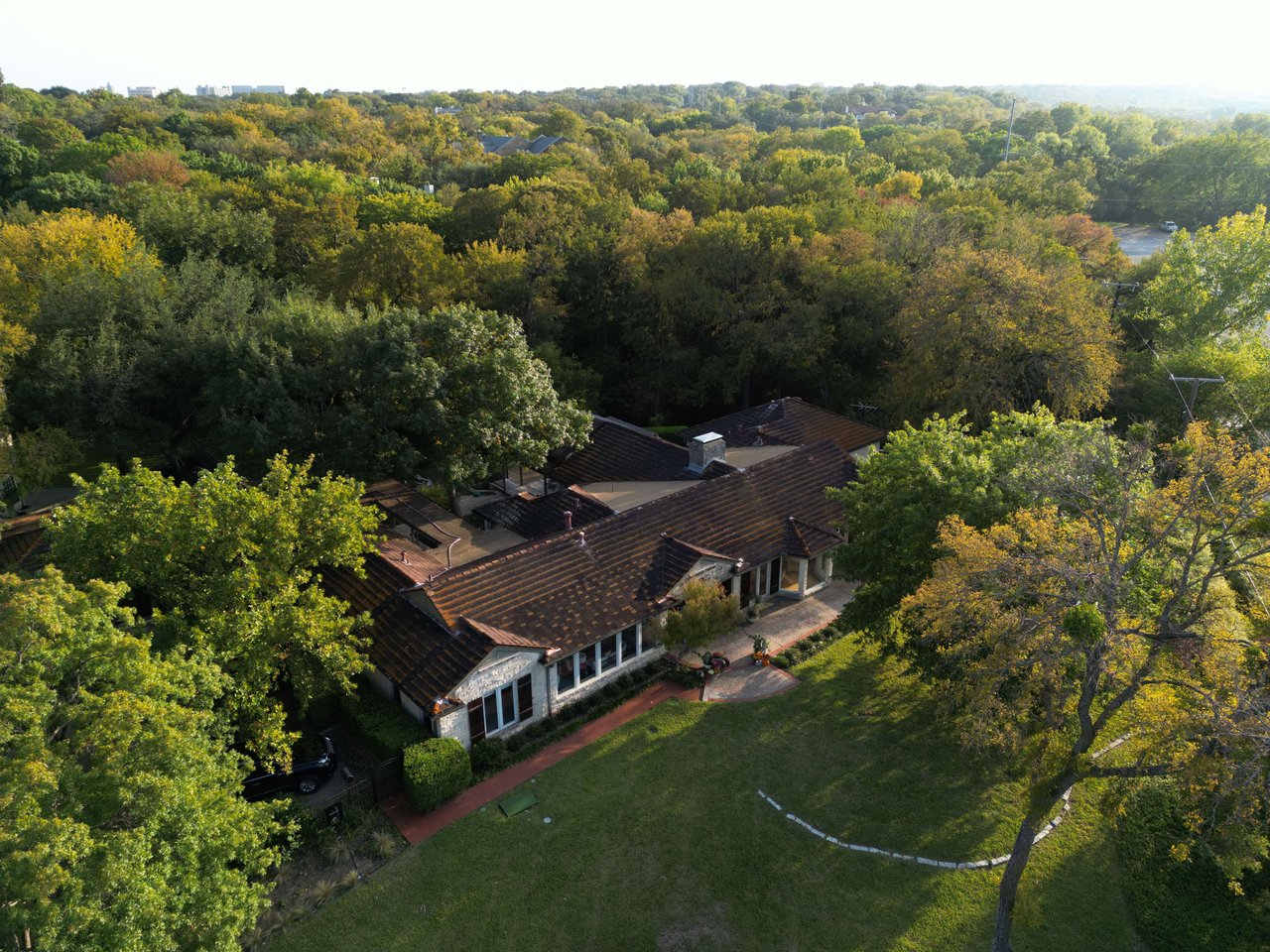 Crestwood
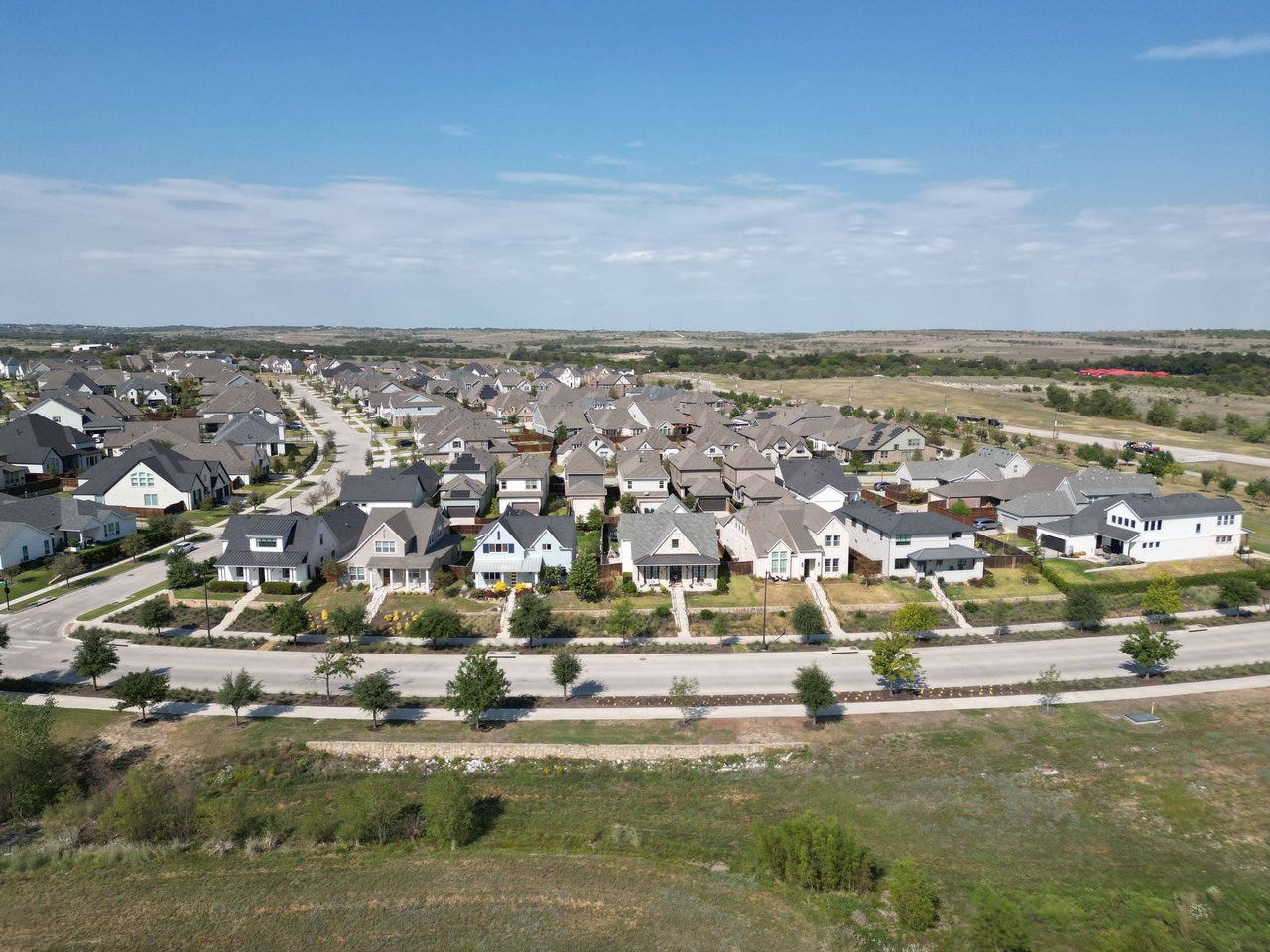 Walsh Ranch
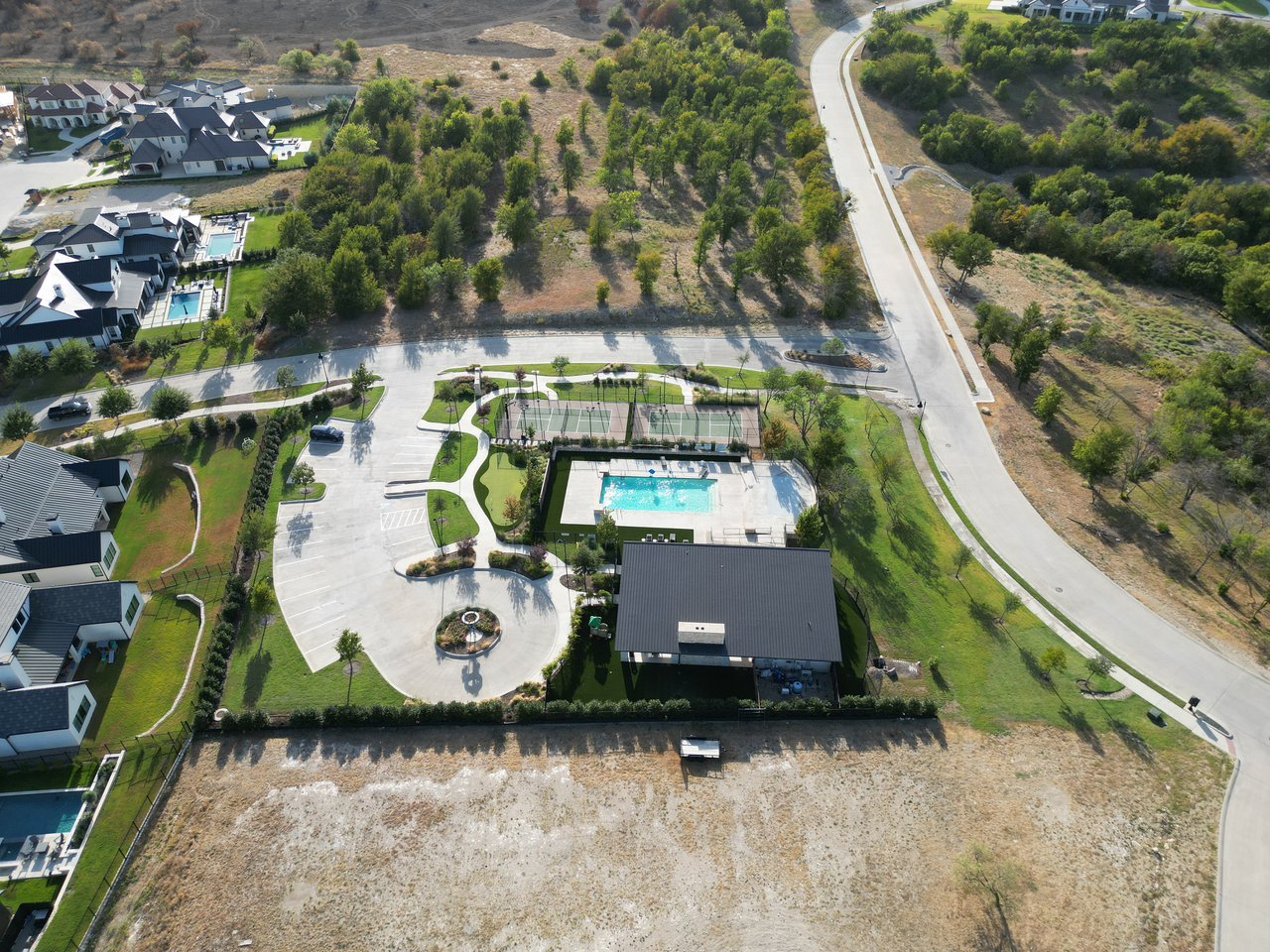 Montserrat / Montrachet
 Bella Flora
 Edwards Ranch Riverhills
 Tavolo Park
 Ryan Place
 Fairmount
 Ridglea
 Ridglea North
 Ridgmar
 Westover Hills
Rivercrest Bluffs & River District
Westover Hills
Rivercrest Bluffs & River District
 Rivercrest, Monticello & North Hi Mount
 Mira Vista
Overton Park
Overton Woods
Westcliff
Arlington Heights
Benbrook
Ventana
Downtown
Linwood
Eagle Mountain & Marine Creek
Beltmill & Watersbend
Heritage & Alliance
Presidio & Tehama Ridge
Wedgwood
North Richland Hills
Hurst
Euless
Bedford
Grapevine
Westlake
Keller
Southlake
Colleyville
Arlington
Burleson
Crowley
Mansfield
Kennedale
Aledo
Weatherford
Azle
Granbury
Springtown
Cleburne
Joshua
Godley
Alvarado
Ponder
Krum
Waxahachie
Midlothian
Poolville
Decatur
Justin
Mira Vista
Overton Park
Overton Woods
Westcliff
Arlington Heights
Benbrook
Ventana
Downtown
Linwood
Eagle Mountain & Marine Creek
Beltmill & Watersbend
Heritage & Alliance
Presidio & Tehama Ridge
Wedgwood
North Richland Hills
Hurst
Euless
Bedford
Grapevine
Westlake
Keller
Southlake
Colleyville
Arlington
Burleson
Crowley
Mansfield
Kennedale
Aledo
Weatherford
Azle
Granbury
Springtown
Cleburne
Joshua
Godley
Alvarado
Ponder
Krum
Waxahachie
Midlothian
Poolville
Decatur
Justin
Stay up to date on the latest real estate trends.
Seller Resources
Your old days on market follow you until you've been gone 30 days — then they vanish completely. 16,465 relisted DFW houses measured.

Home Improvement
About 9% of your price almost regardless of neighborhood — half to all of what one costs to build. And they sell eight days faster.
Buyer Resources
On a new build the listed tax is the vacant lot's bill, and it roughly quadruples in year two — about $526 a month on a $450,000 house.
Buyer Resources
Owned panels add about 3%. Leased panels add nothing — and a listing that doesn't say which gets priced like a lease.

Seller Resources
Your twenty acres are not worth ten times your neighbor's two. Per-acre price falls about a quarter every time a tract doubles.
Owner Resources
I listed one in North Richland Hills that sold in nine days at 99% of asking. The elevator wasn't why — and 121 sales out of 89,302 show why not.

Buyer Resources
Across 40,703 sales in 19 markets, houses on subdivision lots are down about 1% a year while houses on an acre or more are up about 1%. The pattern holds inside the sa… Read more

Owner Resources
What 33,000 Fort Worth Sales Say About Fixing Up Before You List

Owner Resources
Nothing on this list is automatic. One of these took effect nine months ago and almost nobody has filed.
I've trained three appraisers in this market, and every figure on this blog comes from closed sales I pull and model myself. The same analysis, applied to one address.