What a Pool Actually Adds
Home Improvement

Home Improvement
Every spring I get some version of this call. We're thinking about putting in a pool. Will we get it back when we sell?
I finally measured it. 12,741 pools across 89,302 closings in Dallas–Fort Worth, comparing each house against its own neighbors in the same subdivision so the school district, the street and the price point are held still.
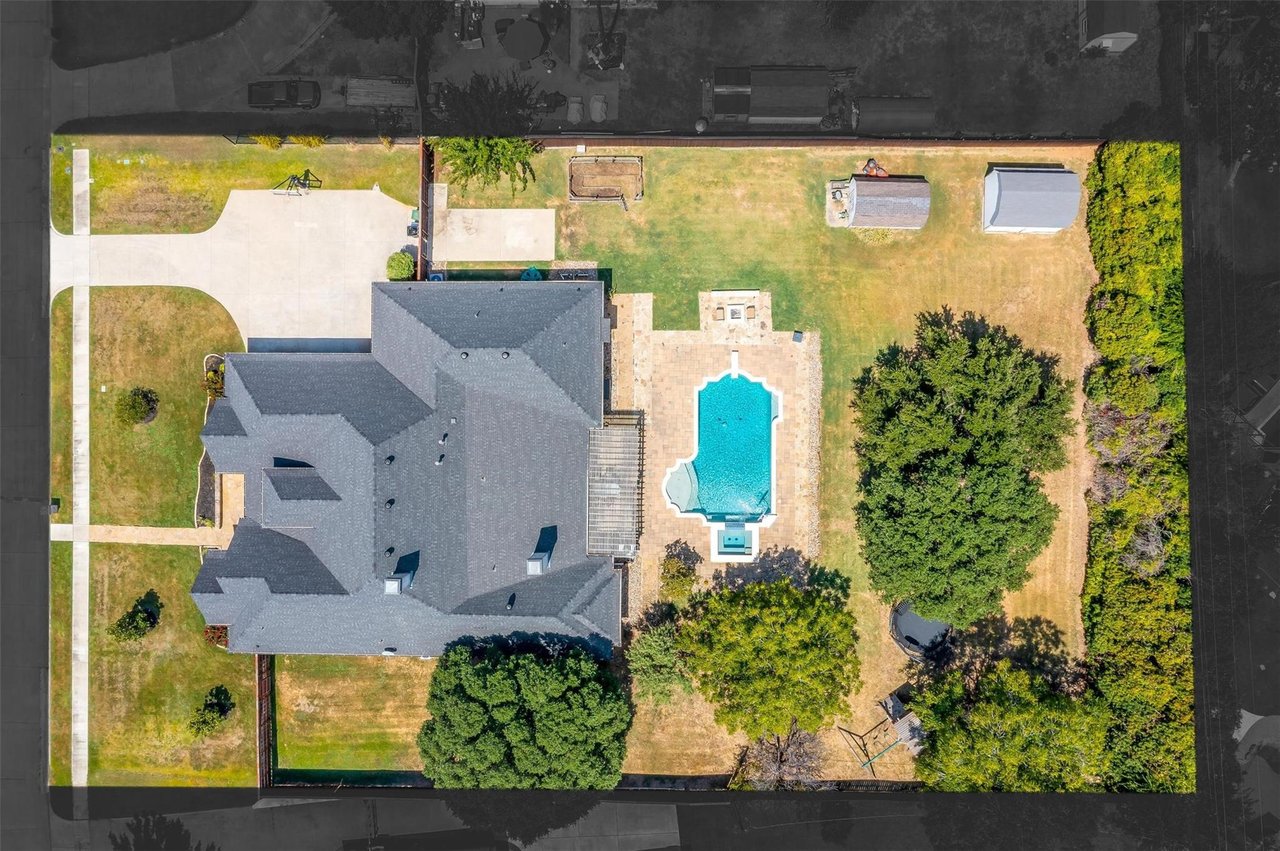
A pool adds about 9% of the price. A custom gunite pool — the kind most people around here build — costs $55,000 to $150,000, typically $80,000 to $120,000. So depending on where your house is, you get back somewhere between a fifth of that and most of it.
That's still a better return than almost anything else you can spend money on at a house. It is not an investment.
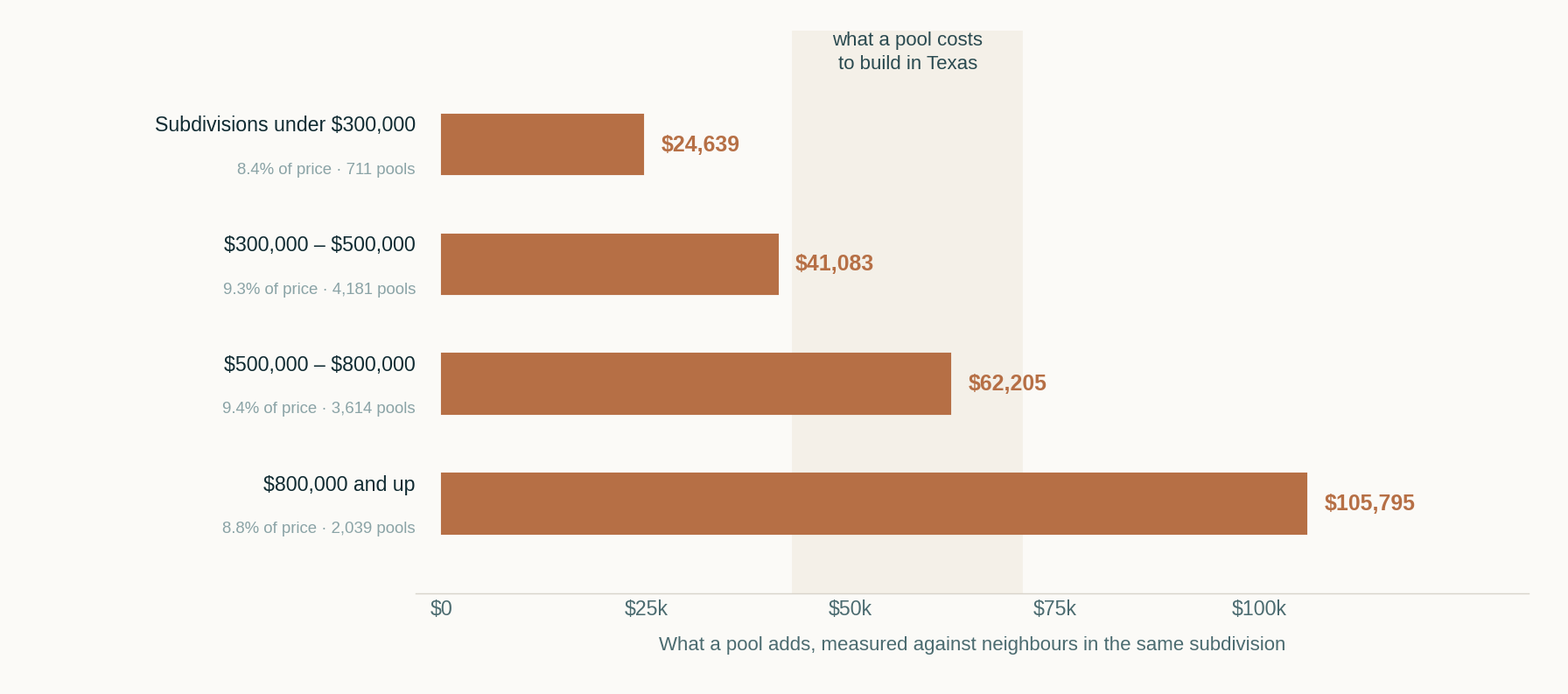
What a pool adds against neighbors in the same subdivision, with the cost of a mid-range Dallas–Fort Worth gunite build shaded.
Neighborhoods where houses sell for | A pool adds | In dollars | You get back |
Under $300,000 | 8.4% | about $24,600 | a fifth to a third |
$300,000 to $500,000 | 9.3% | about $41,100 | a third to a half |
$500,000 to $800,000 | 9.4% | about $62,200 | half to three quarters |
$800,000 and up | 8.8% | about $105,800 | two thirds to most |
What surprised me is how flat the percentage is. A pool is worth about nine percent of the house almost wherever the house is. The dollars diverge four to one across that range purely because the houses do.
Almost every cost figure you'll find online is a statewide average, and statewide averages do not describe this market.
Those guides put a Texas pool at $43,000 to $71,000. That is not what gets built in Dallas–Fort Worth. Local builders quote a custom gunite pool — the dominant type here — at about $55,000 at entry level, $80,000 to $120,000 mid-range, and $150,000 and up for a luxury build. Fiberglass runs $60,000 to $100,000 and vinyl liner $45,000 to $75,000, and neither is common around here.
And those base figures include only basic decking. The things people actually want are extra: premium stone or travertine decking adds $15,000 to $40,000, an integrated spa $15,000 to $30,000, an outdoor kitchen $20,000 to $60,000. Specialty tile, a slide, a grotto or a serious water feature will carry a build past $150,000 without much effort.
Worth saying plainly: a pool without a deck is hard to enjoy. If you are budgeting, the deck belongs inside the number rather than beside it.
If you've seen the number-one piece of pool advice on the internet — never put a pool on a cheap house, you'll lose almost all of it — I want to flag how I nearly repeated it.
The obvious way to run this is to sort the sales into price bands and measure inside each one. Do that, and a pool under $300,000 appears to add just 2.4%, about $6,500. One dollar back in seven. It looks damning.
It's an artifact. Sale price is the thing you're trying to explain, so splitting on it rigs the comparison. Inside a band of $250,000 to $300,000, a house that has a pool and still landed in that band has to be weaker somewhere else than a pool-less house that landed in the same band — otherwise the pool would have carried it into a higher band. The bias bites hardest at the bottom, where the floor truncates most.
Sort instead by the typical price of the subdivision — a fact about the neighborhood, settled before any one house sells — and that 2.4% becomes 8.4%. $6,500 becomes about $24,600.
So the honest version: a pool on an inexpensive house is still the weakest return in the table, and it's still not a reason to build one. But against what a gunite pool actually costs here, it's a fifth to a third of your money, not a seventh.
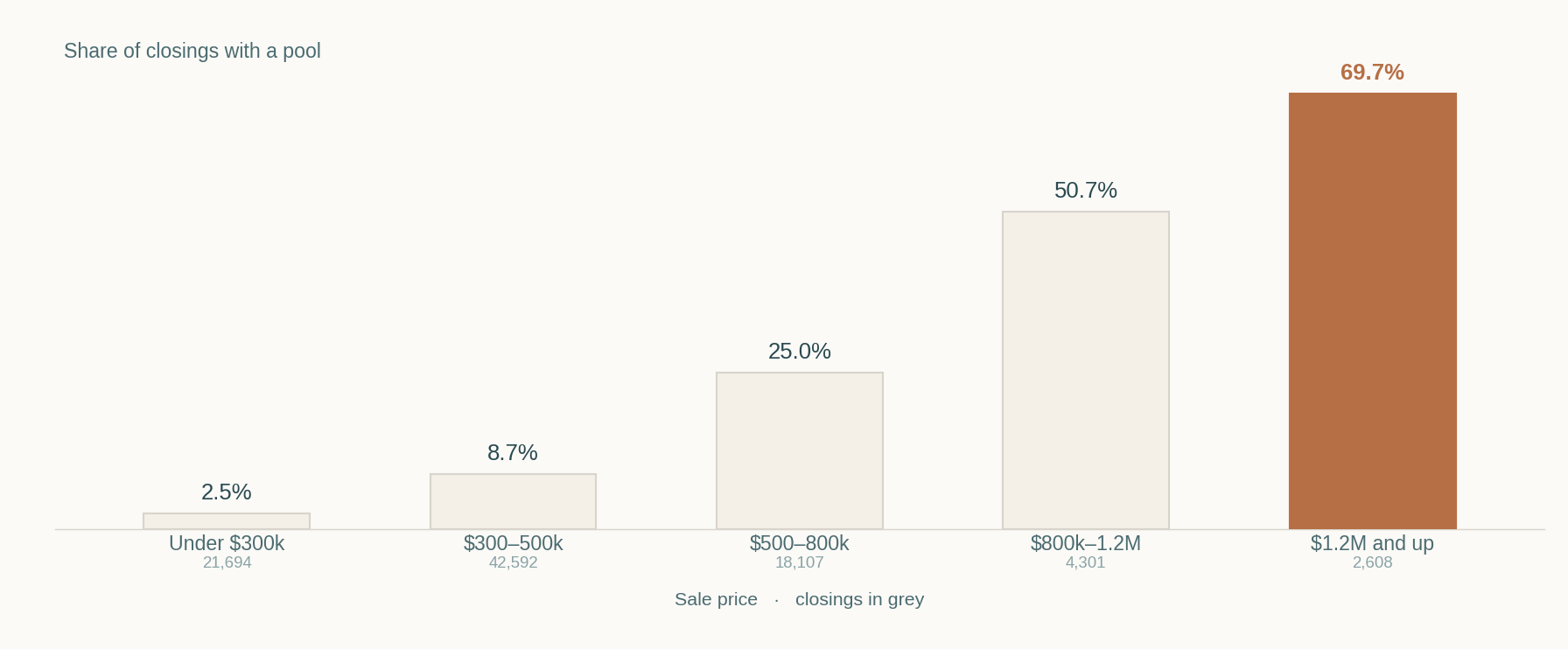
At the top of the market a pool is close to standard. At the bottom it's an anomaly.
The premium is flat. Ownership is anything but. Only 2.5% of closings under $300,000 had a pool. Above $1.2 million, 69.7% did.
I listed a house on Red Rose Trail in North Richland Hills that makes the point. Pool, 0.875 acres, built 2016 — on a street where most of the lots run about a fifth of an acre and the houses close between $457,000 and $604,000. It closed at $1,232,643, one of the highest recorded sales in the city.
No honest reading of that sale credits the pool with nine percent of it. The pool, the lot, the build quality and the year all arrived together, and the market paid for the package. Which is the limitation of every number above, stated plainly: the MLS tells me a pool exists, not whether the house around it is the best one on the street.
That changes how the question gets asked rather than what the number is. Above $1.2 million, the live question is usually what it costs you to not have a pool — and the penalty for lacking a standard feature is often the bigger number. Below $300,000, a pool is unusual, and unusual features scatter. The 8.4% is an average across 711 pools in a market where 97.5% of buyers weren't looking for one. Individual outcomes will vary a lot more than that average suggests.
Market | Pool adds | Median close | In dollars |
Springtown | +15.1% | $400,000 | $60,464 |
+14.3% | $444,350 | $63,663 | |
+13.8% | $448,050 | $61,900 | |
+13.6% | $360,000 | $49,045 | |
+12.8% | $289,000 | $37,009 | |
+12.3% | $565,950 | $69,613 | |
+12.2% | $412,990 | $50,174 | |
+11.4% | $490,000 | $55,669 | |
Azle | +11.2% | $335,925 | $37,554 |
+11.0% | $360,000 | $39,571 | |
Fort Worth | +10.2% | $350,000 | $35,641 |
+9.2% | $490,000 | $44,898 | |
+8.4% | $1,355,000 | $113,239 | |
+7.9% | $335,000 | $26,287 | |
+7.7% | $669,500 | $51,783 | |
+6.4% | $589,000 | $37,431 | |
+6.2% | $387,500 | $24,145 | |
+5.3% | $351,500 | $18,686 |
Springtown runs nearly three times the percentage Hurst does.
And the geography makes sense. The strongest markets are all west and rural-fringe — Springtown, Decatur, Weatherford, Granbury, Aledo, Azle — where lots are big, summers are long, and a pool reads as part of the property rather than an addition to it. The weakest are the built-out mid-cities: Hurst, Bedford, Grapevine. Small lots, and pools common enough to be unremarkable.
Notice too that percentage and dollars rank differently. Cleburne has a high percentage and a modest dollar figure because the houses are inexpensive. Southlake is near the bottom on percentage and the top on dollars at $113,239.
Conventional wisdom says a pool narrows your buyer pool and slows the sale. In this data it did the opposite.
Within the same subdivisions, houses with a pool went under contract in a median 24 days against 32, and closed at 97.7% of original asking against 97.1%.
Eight days faster and a bit more of your price. Pools cluster where buyers expect them, so the person shopping that street usually wants one.
If you're going to swim in it, build it. You're buying six months a year of your own backyard. Across most of the market you'll recover somewhere between a third and three quarters of the build cost, which still makes it one of the better-returning things you can do with that money — just don't mistake it for getting your money back, and remember that none of it touches the ten years of chemicals, electricity, insurance and resurfacing in between.
If you're about to sell, don't build one to sell. You won't beat the timeline, and a new pool doesn't reset the clock on anything.
If your house is inexpensive, go in knowing it's the weakest case. A fifth to a third back, and the buyer pool that'll care about it is small.
If you're buying a house with a pool, price the upkeep. Routine service runs $80 to $150 a month before you touch repairs, resurfacing, higher insurance or the fence Texas requires. That's real money and it isn't in the listing.
The MLS records that a pool exists — not whether it's a $45,000 vinyl rectangle or a $250,000 gunite build with a spa, slide, grotto and outdoor kitchen. Everything above is an average of both. So a simple pool probably does slightly worse than these numbers and an elaborate one slightly better, and neither shows condition: a twenty-year-old pool needing resurfacing looks identical in the data to one finished last spring.
If you want the technical version — confidence intervals, the full method, and how this gets adjusted in an appraisal — it's on my appraisal site: what a pool adds to a house.
I'm a Texas broker and a Certified Residential Appraiser, which means I can tell you what a pool is doing in your subdivision rather than what the national average says — and the gap between those two is a factor of three.
Browse active listings in this price range, or call or text (682) 207-4310, or send me a note.
Based on NTREIS closed sales of detached single-family homes across Dallas–Fort Worth, 2023 through September 2026 — 89,302 closings, 12,741 with a pool. Premiums are measured within subdivisions containing both pool and non-pool sales, holding living area, lot size, year built and sale date constant, with standard errors clustered by subdivision, and grouped by the median sale price of the subdivision rather than of the individual house. Build costs are published 2026 ranges from Dallas–Fort Worth pool builders, not independent estimates. The MLS records only whether a pool exists, not its type, size or condition. Nothing here is an appraisal or a valuation of any particular property.
 Tanglewood
 Crestwood
 Walsh Ranch
 Montserrat / Montrachet
 Bella Flora
 Edwards Ranch Riverhills
 Tavolo Park
 Ryan Place
 Fairmount
 Ridglea
 Ridglea North
 Ridgmar
 Westover Hills
Rivercrest Bluffs & River District
Westover Hills
Rivercrest Bluffs & River District
 Rivercrest, Monticello & North Hi Mount
 Mira Vista
Overton Park
Overton Woods
Westcliff
Arlington Heights
Benbrook
Ventana
Downtown
Linwood
Eagle Mountain & Marine Creek
Beltmill & Watersbend
Heritage & Alliance
Presidio & Tehama Ridge
Wedgwood
North Richland Hills
Hurst
Euless
Bedford
Grapevine
Westlake
Keller
Southlake
Colleyville
Arlington
Burleson
Crowley
Mansfield
Kennedale
Aledo
Weatherford
Azle
Granbury
Springtown
Cleburne
Joshua
Godley
Alvarado
Ponder
Krum
Waxahachie
Midlothian
Poolville
Decatur
Justin
Mira Vista
Overton Park
Overton Woods
Westcliff
Arlington Heights
Benbrook
Ventana
Downtown
Linwood
Eagle Mountain & Marine Creek
Beltmill & Watersbend
Heritage & Alliance
Presidio & Tehama Ridge
Wedgwood
North Richland Hills
Hurst
Euless
Bedford
Grapevine
Westlake
Keller
Southlake
Colleyville
Arlington
Burleson
Crowley
Mansfield
Kennedale
Aledo
Weatherford
Azle
Granbury
Springtown
Cleburne
Joshua
Godley
Alvarado
Ponder
Krum
Waxahachie
Midlothian
Poolville
Decatur
Justin
Stay up to date on the latest real estate trends.

H-E-B is coming to Chisholm Trail and Oakmont in late 2028. I measured six North Texas stores to find out what that does to home values. It doesn't — but it changes ho… Read more
Home Improvement
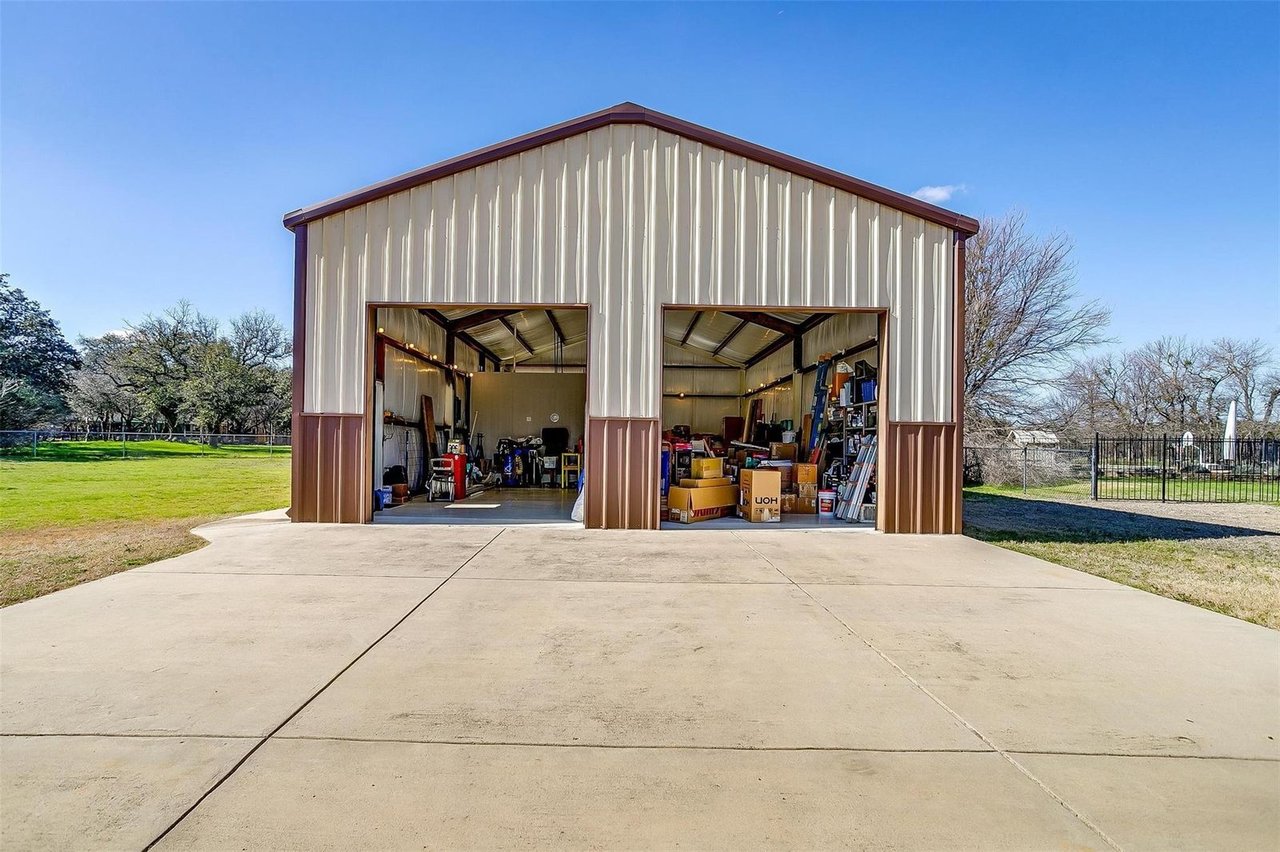
A shop with electricity adds about 6% of the sale price. The same building without power adds 2.6% — the same as a storage shed.
Home Improvement
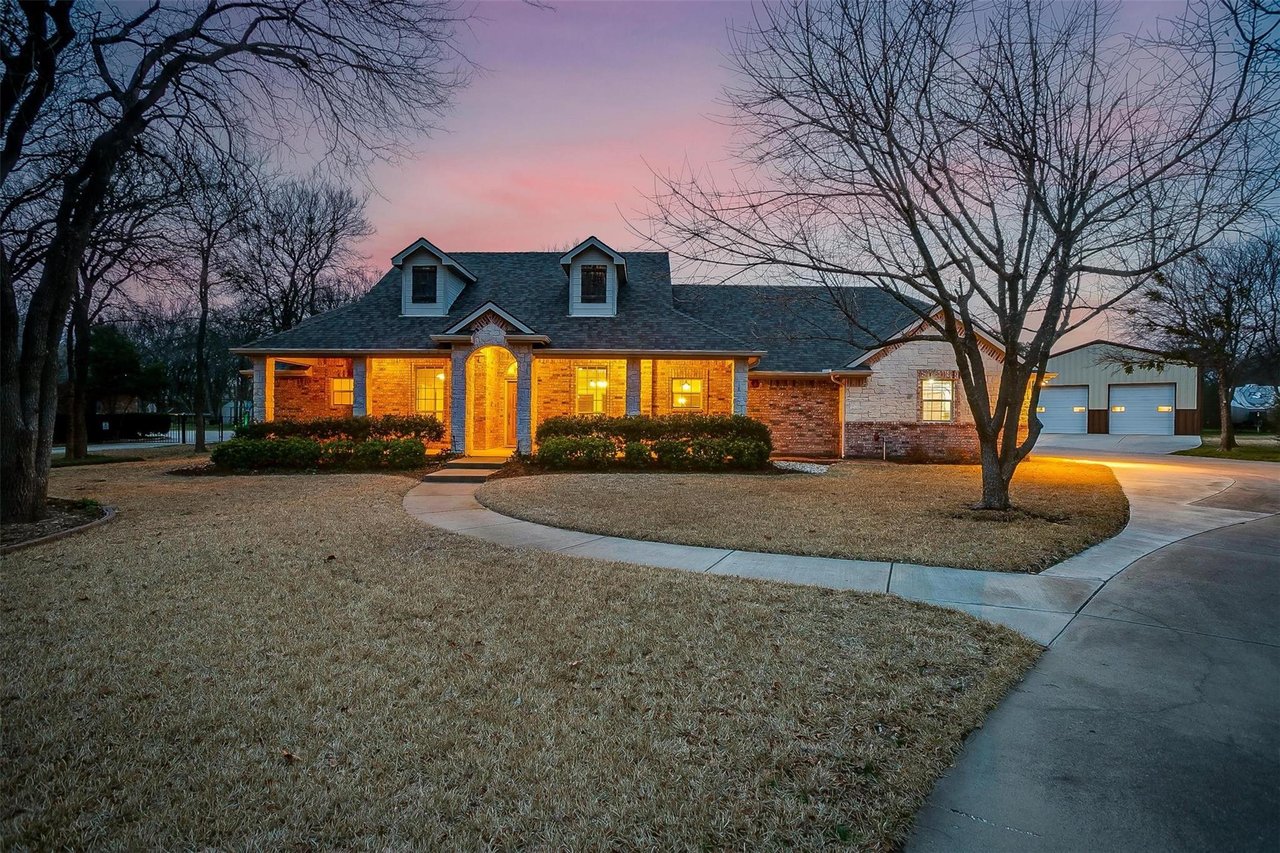
2,002 accessory units measured. Having one adds about 7% — and how big it is adds nothing, so build the smallest one that does the job.
Seller Resources
Your old days on market follow you until you've been gone 30 days — then they vanish completely. 16,465 relisted DFW houses measured.
Home Improvement
About 9% of your price almost regardless of neighborhood — half to all of what one costs to build. And they sell eight days faster.
Buyer Resources
On a new build the listed tax is the vacant lot's bill, and it roughly quadruples in year two — about $526 a month on a $450,000 house.
Buyer Resources
Owned panels add about 3%. Leased panels add nothing — and a listing that doesn't say which gets priced like a lease.
Seller Resources
Your twenty acres are not worth ten times your neighbor's two. Per-acre price falls about a quarter every time a tract doubles.
Owner Resources
I listed one in North Richland Hills that sold in nine days at 99% of asking. The elevator wasn't why — and 121 sales out of 89,302 show why not.
I've trained three appraisers in this market, and every figure on this blog comes from closed sales I pull and model myself. The same analysis, applied to one address.