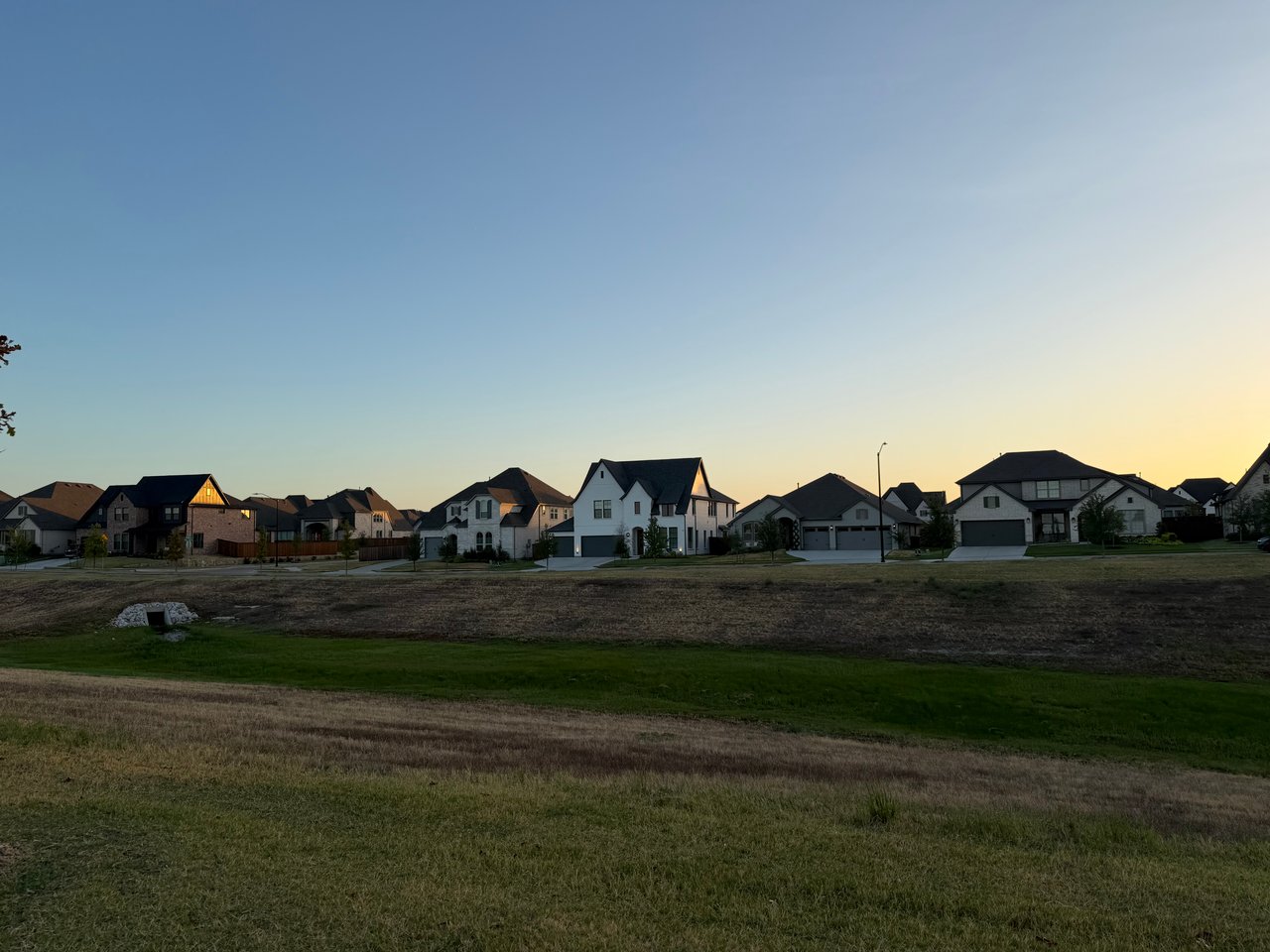
Tavolo Park is a 468-acre master-planned community in southwest Fort Worth, just off Chisholm Trail Parkway — about fifteen minutes from Clearfork and TCU, ten from the cultural district, and two miles from Benbrook Lake. Developed by Provident Realty Advisors and named for the Italian word for table, which isn't only branding: the centerpiece is a clubhouse called The Big Table, with a resort-style pool, event lawn, fire pit and beer garden. Around it, a town lake, parks and playgrounds, greenbelts and miles of trails.
Homes run from the high $400s into the $700s on lots mostly between 6,000 and 7,000 square feet. Builders currently or recently selling here include David Weekley, Highland Homes and Shaddock Homes, plus Ladera, a separate gated 55-plus section.
I should tell you up front: I live in Tavolo Park. I'm also a Fort Worth broker and a Certified Residential Appraiser, and I've represented a buyer purchasing a David Weekley home here. So this is part neighborhood description and part what I'd tell a friend who asked — including the parts a marketing page wouldn't.
The schools question, answered from inside
It's the first thing people ask, so I won't bury it.
Tavolo Park is Crowley ISD — all 189 listings I reviewed. Zoned campuses are June W. Davis Elementary, Sue Crouch Intermediate, Summer Creek Middle and North Crowley High, and plenty of families here use them.
But here's what a listing description won't tell you: a large share of families here educate outside the zoned district, and the options for doing it are unusually good.
- Great Hearts Lakeside — tuition-free public charter, classical liberal arts, on Harris Parkway and effectively in the neighborhood. Opened 2020, growing a grade a year toward K–12.
- BASIS Benbrook — a second tuition-free charter, accelerated college-prep, minutes away in Benbrook.
- Christian Life Preparatory School on South Hulen — a collaborative-model school, and the one many of the co-op families here organize around.
- Southwest Christian and Trinity Valley, both an easy drive.
- An active homeschool community inside Tavolo Park itself.
Two tuition-free charters within a few minutes of each other is unusual, and it's a large part of why this neighborhood attracts the families it does.
Buyers who screen by district rating alone will skip Tavolo Park, and a lot of them would have loved living here. The honest framing isn't that the schools are better than you think — it's that families here have solved schooling several different ways, and the infrastructure for all of them is right here. If you want to talk through charter lottery timing or the co-op options, that's a conversation I can have from the inside.
What the market is actually doing
On market conditions, which matter differently here than in an established neighborhood. Across 95 closed sales, price per square foot in Tavolo Park has moved +0.1% a year once you control for house size — p = 0.94, which is as close to perfectly flat as a market gets. Values have held.
Two things follow, and they pull in different directions. Of the eighteen Fort Worth neighborhoods I measure, none shows a statistically significant decline in price per foot, so nobody buying here is catching a falling market. But a flat market is also one where you don't outgrow a high purchase price quickly, which is why what you pay a builder today matters more than it did when everything was appreciating. Resale competes with the builder's own inventory, and the builder can adjust incentives in a way you can't.
The tax rate, and the thing that happened to me
The combined 2025 rate is 2.3887% — Crowley ISD 1.2552, City of Fort Worth 0.67, Tarrant County 0.1862, plus hospital and college district levies.
No PID and no MUD. Worth saying plainly, because many west-side master-planned communities carry one and buyers assume the worst. Walsh runs about 2.69% once its PID is counted. Tavolo Park's rate is higher for a different reason — Crowley ISD's school rate is simply the highest of the west-side districts, above Fort Worth ISD's 1.0291 and Aledo's roughly 1.19. You pay it in the rate, not a separate assessment, and it ends when you sell.
Now the part anyone buying new construction here should hear, because it happened at my own address.
A new home sits on the tax roll at land value only until the county captures the improvement. My parcel was assessed at $44,100 for 2024, with a bill around $1,063. For 2025, with the house on the roll, assessed value went to $658,429 and the bill to $15,728.
A fourteen-fold increase in one year, and completely normal. It's also the most common reason a new-construction buyer's payment jumps in year two — the lender escrowed off the land-only figure.
Ask your lender to escrow off the expected assessed value, not the current one, and file your homestead exemption the January after you close. I wrote up the full sequence in the first year in a new build.
What the HOA buys
Dues run roughly $650 to $1,250 a year, clustering near $1,000, covering full use of facilities: The Big Table, the trails, the parks, and a community pool that's genuinely a good size rather than the token rectangle a lot of communities call a pool.
About eighty dollars a month is low for that package. Between no PID and dues at this level, the recurring cost of living here is simpler than in most communities it competes with.
What the sales show
Every Tavolo Park listing over the two years ending September 2026 — 189, including everything that came off the market without selling. Ninety-six closed, at a median of $560,599 on 2,566 square feet, about $210 per foot.
The most useful finding: new construction and resale close at the same price per foot, but new takes twice as long.
- Resale: $212 per foot, 47 days, closing at 96.4% of original list
- New construction: $210 per foot, 96 days, closing at 92.8%
That gap is what a builder incentive looks like from outside. Rate buydowns, closing-cost credits and design-center allowances don't reduce the recorded sale price — they get paid in time on market and in concessions that never show up in the per-foot number.
Buying? Builder inventory standing four or five months is where the negotiating room is, and it usually isn't in the price. Get the current rate and closing-cost offer in writing before you fall for a plan — what's actually in a builder's contract covers the rest.
Selling? Your 47-day market is faster than the builder's 96, and you hold 96 cents on the dollar against their 93. Most sellers here price as though they're competing on equal footing. They aren't — they're faster, and speed is worth money to a buyer with a lease ending.
Never price off a per-foot average here
In Tavolo Park, price per square foot falls sharply as homes get larger:
- Under 2,200 sq ft: $239 · 2,200–2,600: $226 · 2,600–3,000: $198
- 3,000–3,400: $194 · Over 3,400: $175
A 27% decline, and not a quirk. A kitchen, roof and foundation don't scale with square footage, so fixed costs spread thinner as the house grows. What makes Tavolo Park the clean case is that lot size is essentially constant across every band — about 6,300 square feet whether the house is 2,000 feet or 4,000. Nothing offsets the effect, so the slope runs steep and straight.
Compare Walsh, where homesites grow with the house and the slope flattens, or Montrachet, where land dominates and it inverts entirely. I explain the mechanism in two agents, two prices.
Practically: a 3,500-foot house priced at the community median of $210 a foot is asking roughly twenty percent over what homes that size actually sell for. Before you set a number, find out where your plan sits on that curve rather than where the community median sits.
Where the market stands
As of September 2026 there are 32 active listings against a closing pace near 4.7 a month — about seven months of supply, which is a buyer's market by conventional reading.
Active listings ask around $228 a foot while sales clear near $210, and 41% of standing listings have already cut their price. Roughly three in ten listings over the past two years came off the market without selling, concentrated almost entirely in resale rather than builder inventory.
That last part is worth reading correctly. These are recent-build homes with owners who have equity and, in most cases, nowhere they have to be. When a listing doesn't produce the number, the house comes off rather than down. The builder side behaves differently — a builder pulling a spec is repositioning inventory on its own schedule, not waiting out a market.
Days on market went 60 in 2024, 48 in 2025, 96 so far in 2026 — while the share of original list price sellers receive improved, 91% to 95%. Sellers are pricing more carefully and still waiting longer. That's a market absorbing supply, and it favors a patient buyer.
If you want to build here
David Weekley is selling what it calls the final phase — 50-foot homesites, plans from about 2,074 to 3,410 square feet. Highland and Shaddock are also active, and Ladera continues in the 55-plus section. The window for choosing your own lot is closing rather than opening, so the practical question isn't whether to wait for a better market — it's whether the homesite you'd want will still exist.
Before you sign: find out what's planned behind and beside the lot; get the incentive in writing and know what happens to it if closing slips; settle the tax escrow question at application; and check drainage and grade — North Texas clay, tight lots, and the least-warranted thing about a homesite. Know before you close which drainage problems are the builder's responsibility under your contract and which become yours. That line is where the money is.
What it's like to live here
The design intent — a community organized around a shared table — mostly works. The Big Table gets used. People walk the trails. The town lake and the parks aren't renderings.
It's also gotten more practical: BJ's Wholesale Club opened on Harris Parkway in May 2026, minutes away, with a gas station. Chisholm Trail Parkway puts downtown and the medical district within a short drive. For a neighborhood this far southwest, the errand radius is small.
If you're thinking about Tavolo Park
I live here, I hold a Texas broker's license, and I'm a Certified Residential Appraiser — so I can tell you what a given plan is actually worth rather than what it's listed for. I can also usually look at a lot and tell you whether that home is likely to need drainage work, what holds the cost down, and how to get the builder to pay when the contract makes it their responsibility.
For buyers: where the incentive is real and where it's theater, which size band you're getting value in, and what the schools situation genuinely looks like from inside the neighborhood rather than from a rating site.
For sellers: a correctly positioned resale here still goes in about 47 days at 96.4% of original list. Your competition is a builder four streets over who takes twice as long and gives up more at closing. That's an advantage, and most listings here don't price like it.
Call or text (682) 207-4310, or send me a note. If you want to walk the neighborhood, I'm already here.
Sales figures are medians from NTREIS listings and closed sales for the two years ending September 2026, reported in aggregate. Tax rates, builder incentives, HOA dues, lot availability and school assignments change — confirm current figures for a specific property before relying on them.