The Tax Number on the Listing Is Not Your Tax Bill
Buyer Resources
Buyer Resources
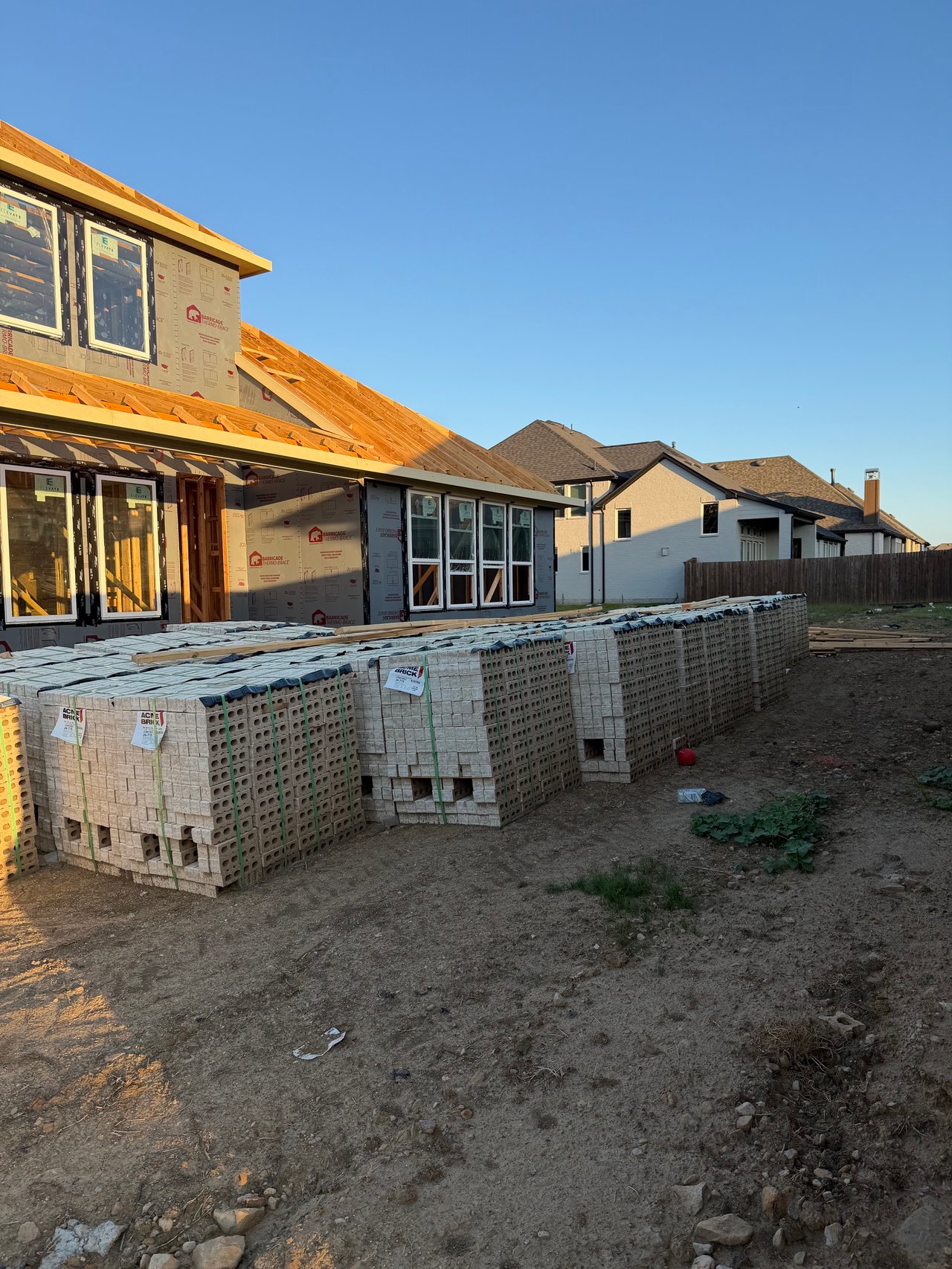
If you are buying new construction, the property tax figure on the listing is wrong. Not misleading, not optimistic — wrong, by about four times.
I pulled the assessed tax of record against the actual sale price on 60,250 closings across Dallas–Fort Worth. Here is what it looks like sorted by how old the house was when it sold.
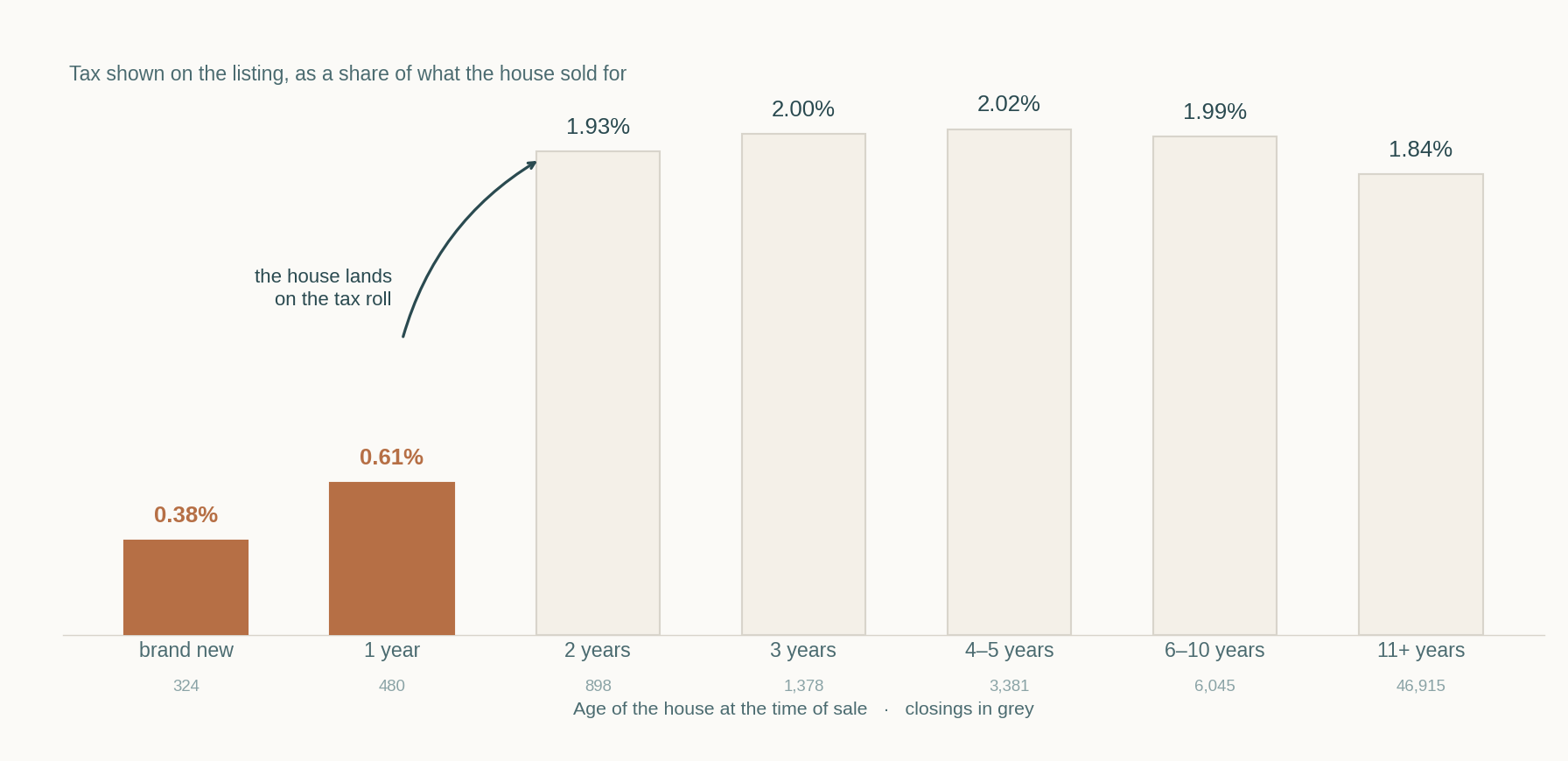
The tax on a new-construction listing is the assessment on a vacant lot. The house arrives on the roll in year two.
Age when it sold | Sales | Tax as % of price | Median tax shown |
Brand new | 324 | 0.38% | $1,920 |
1 year old | 480 | 0.61% | $3,118 |
2 years old | 898 | 1.93% | $8,406 |
3 years | 1,378 | 2.00% | $8,478 |
4 to 5 years | 3,381 | 2.02% | $8,439 |
11+ years | 46,915 | 1.84% | $6,767 |
It is not a gradual climb. It is a cliff, and it falls in the same place every time.
Texas appraisal districts assess property as of January 1. A house that was framed in March and closed in September was a vacant lot on the assessment date, so the tax record attached to it reflects dirt. The following January the district puts the house on the roll, and the bill becomes a real one.
Nobody is hiding anything. The listing reports the tax record that exists. It just happens that on a new house, that record describes a lot with nothing on it.
The median new build in this data sold for $450,000.
| Rate | Per year | Per month |
What the listing showed | 0.46% | $2,054 | $171 |
What it becomes | 1.86% | $8,362 | $697 |
Difference | +1.40 pts | +$6,308 | +$526 |
Five hundred and twenty-six dollars a month. At today's rates that is the payment gap between a $450,000 house and a $533,000 one. And it usually does not arrive as a letter you were expecting — it arrives as an escrow analysis that raises your payment and bills you for the months you underpaid.
So before you write an offer on new construction: call the county appraisal district and ask what the assessment will be once the house is on the roll. Budget from that number. It takes one phone call and it is the difference between comfortable and stretched.
Now strip out everything under six years old, so every house has been fully assessed for years, and compare markets honestly.
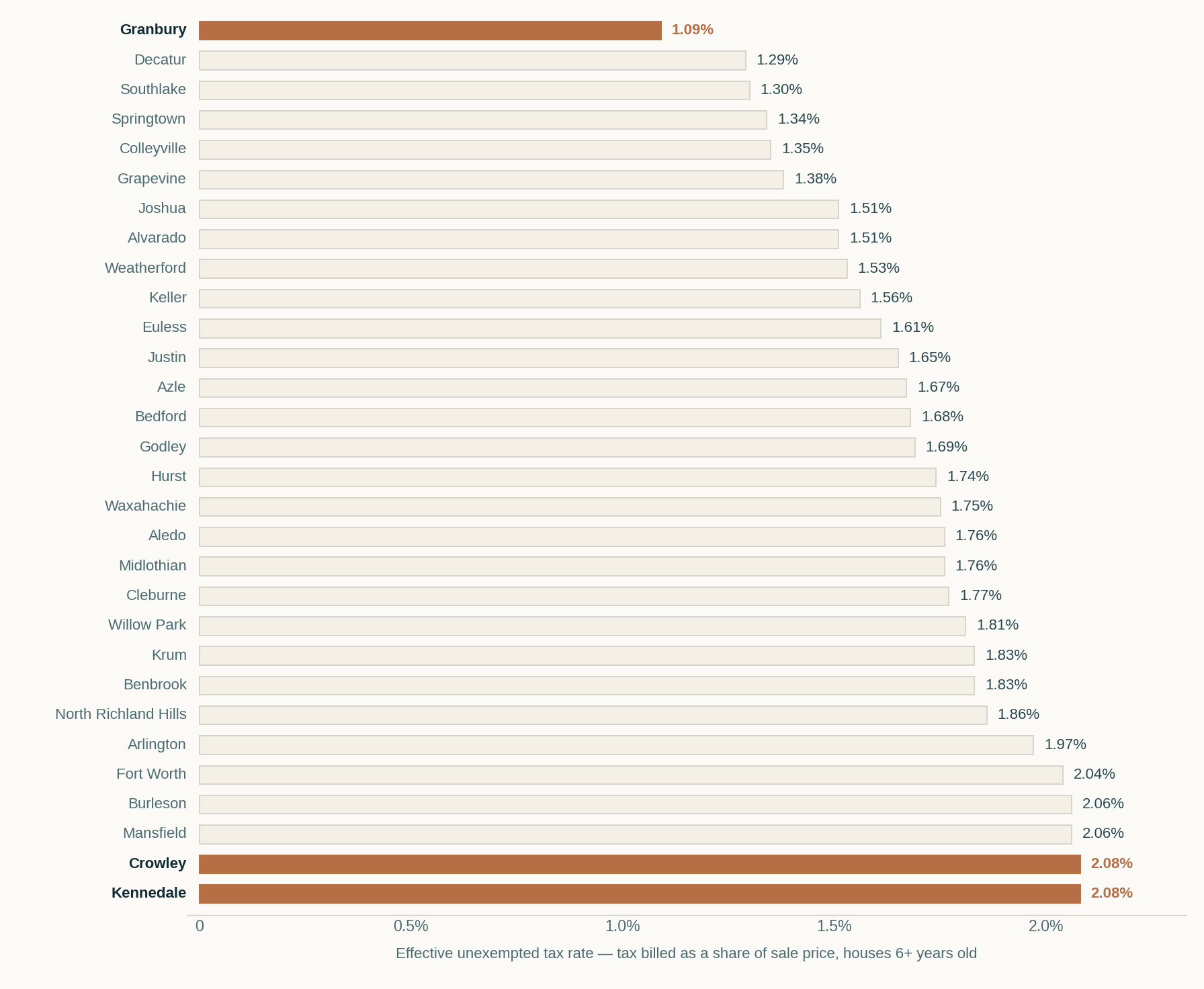
Tax billed as a share of sale price, houses 6+ years old, before homestead exemptions.
The range is 1.09% to 2.08%. On a $400,000 house that is $4,360 a year in Granbury against $8,320 in Kennedale — a difference of $3,934 a year, or $328 a month, for the same house.
The low end: Granbury at 1.09%, then Decatur 1.29%, Southlake 1.30%, Springtown 1.34%, Colleyville 1.35%, Grapevine 1.38%.
The high end: Arlington 1.97%, Fort Worth 2.04%, Burleson 2.06%, Mansfield 2.06%, Crowley 2.08%, Kennedale 2.08%.
Here is the part that trips people up. Across these 30 markets, the tax rate and the median price run in opposite directions. Southlake and Colleyville are near the bottom of the rate table — at medians of $1.31 million and $979,000.
That is just how ad valorem taxation works. A jurisdiction with a large, expensive tax base funds itself at a lower rate. One with a modest base cannot. So a low rate is often a symptom of expensive housing rather than a break on it.
Which makes the real exceptions worth naming. Granbury is 1.09% on a $392,500 median — low rate and moderate price together. Decatur is 1.29% on $400,000. Springtown is 1.34% on $365,000. Those three are genuinely inexpensive to own rather than merely cheap to tax.
Rate alone is the wrong comparison. What matters is principal, interest and tax together. Here is the median house in each market at 20% down and a 6.5% rate, with the unexempted tax added:
Market | Median price | P&I | Tax | Total |
$259,000 | $1,310 | $382 | $1,692 | |
$272,000 | $1,375 | $343 | $1,718 | |
Crowley | $290,000 | $1,466 | $502 | $1,968 |
$316,750 | $1,602 | $447 | $2,049 | |
$327,000 | $1,653 | $411 | $2,064 | |
Arlington | $326,000 | $1,648 | $536 | $2,184 |
Springtown | $365,000 | $1,846 | $408 | $2,253 |
Fort Worth | $338,000 | $1,709 | $575 | $2,284 |
Granbury | $392,500 | $1,985 | $358 | $2,343 |
$380,000 | $1,921 | $485 | $2,407 | |
Decatur | $400,000 | $2,023 | $431 | $2,453 |
Mansfield | $415,000 | $2,098 | $714 | $2,812 |
$444,000 | $2,245 | $650 | $2,895 | |
Grapevine | $575,000 | $2,908 | $663 | $3,570 |
$566,250 | $2,863 | $812 | $3,675 | |
$656,000 | $3,317 | $853 | $4,170 |
Granbury has the lowest rate on the list and still costs more per month than Cleburne, Alvarado, Crowley, Azle, Joshua or Arlington — because the houses cost more. Rate is one input, not the answer.
Every figure here is the tax billed before exemptions, divided by what the house actually sold for. Your bill with a homestead exemption will be lower.
I did it that way on purpose. Exemptions attach to the owner, not the property — two identical houses across the street carry different bills depending on who lives in them and how old they are. Taking exemptions out is the only way to compare jurisdictions rather than residents. To turn any figure here into your likely bill, subtract the exemptions you qualify for, which the appraisal district can confirm.
A protest is not an argument that the district was sloppy. It is an argument about what your property was worth on January 1 of that tax year, supported by comparable sales as of that date. That is a retrospective valuation with a fixed effective date, and it either rests on real comparable analysis or it doesn't.
I do that work through my appraisal practice, and the fee is never contingent on the outcome. If you want the technical version — why an appraisal district value and a market value are different exercises, and what an ARB hearing actually turns on — it's here: the tax number on the listing is not your tax bill.
I'm a Texas broker and a Certified Residential Appraiser, which means when we're comparing two towns I can tell you what the houses actually cost to own rather than what they list for — and on new construction, what the payment becomes in year two.
Browse active listings in this price range, or call or text (682) 207-4310, or send me a note.
Based on NTREIS closed sales carrying an assessed tax of record across Dallas–Fort Worth, 2023 through September 2026 — 60,250 closings. Rates are the tax billed before exemptions divided by the actual sale price, reported as market-level medians. They are not published jurisdictional rates and a single address may sit in a different combination of taxing districts than its market median implies. Monthly figures assume 20% down and a 6.5% fixed rate and exclude insurance, HOA and mortgage insurance. Tax rates and exemptions change annually. Nothing here is tax advice or an appraisal; confirm any figure with the county appraisal district and your tax advisor.
 Tanglewood
 Crestwood
 Walsh Ranch
 Montserrat / Montrachet
 Bella Flora
 Edwards Ranch Riverhills
 Tavolo Park
 Ryan Place
 Fairmount
 Ridglea
 Ridglea North
 Ridgmar
 Westover Hills
Rivercrest Bluffs & River District
Westover Hills
Rivercrest Bluffs & River District
 Rivercrest, Monticello & North Hi Mount
 Mira Vista
Overton Park
Overton Woods
Westcliff
Arlington Heights
Benbrook
Ventana
Downtown
Linwood
Eagle Mountain & Marine Creek
Beltmill & Watersbend
Heritage & Alliance
Presidio & Tehama Ridge
Wedgwood
North Richland Hills
Hurst
Euless
Bedford
Grapevine
Westlake
Keller
Southlake
Colleyville
Arlington
Burleson
Crowley
Mansfield
Kennedale
Aledo
Weatherford
Azle
Granbury
Springtown
Cleburne
Joshua
Godley
Alvarado
Ponder
Krum
Waxahachie
Midlothian
Poolville
Decatur
Justin
Mira Vista
Overton Park
Overton Woods
Westcliff
Arlington Heights
Benbrook
Ventana
Downtown
Linwood
Eagle Mountain & Marine Creek
Beltmill & Watersbend
Heritage & Alliance
Presidio & Tehama Ridge
Wedgwood
North Richland Hills
Hurst
Euless
Bedford
Grapevine
Westlake
Keller
Southlake
Colleyville
Arlington
Burleson
Crowley
Mansfield
Kennedale
Aledo
Weatherford
Azle
Granbury
Springtown
Cleburne
Joshua
Godley
Alvarado
Ponder
Krum
Waxahachie
Midlothian
Poolville
Decatur
Justin
Stay up to date on the latest real estate trends.
Seller Resources
Your old days on market follow you until you've been gone 30 days — then they vanish completely. 16,465 relisted DFW houses measured.

Home Improvement
About 9% of your price almost regardless of neighborhood — half to all of what one costs to build. And they sell eight days faster.
Buyer Resources
On a new build the listed tax is the vacant lot's bill, and it roughly quadruples in year two — about $526 a month on a $450,000 house.
Buyer Resources
Owned panels add about 3%. Leased panels add nothing — and a listing that doesn't say which gets priced like a lease.

Seller Resources
Your twenty acres are not worth ten times your neighbor's two. Per-acre price falls about a quarter every time a tract doubles.
Owner Resources
I listed one in North Richland Hills that sold in nine days at 99% of asking. The elevator wasn't why — and 121 sales out of 89,302 show why not.

Buyer Resources
Across 40,703 sales in 19 markets, houses on subdivision lots are down about 1% a year while houses on an acre or more are up about 1%. The pattern holds inside the sa… Read more

Owner Resources
What 33,000 Fort Worth Sales Say About Fixing Up Before You List

Owner Resources
Nothing on this list is automatic. One of these took effect nine months ago and almost nobody has filed.
I've trained three appraisers in this market, and every figure on this blog comes from closed sales I pull and model myself. The same analysis, applied to one address.