What a Workshop Adds to a House
Home Improvement
Home Improvement
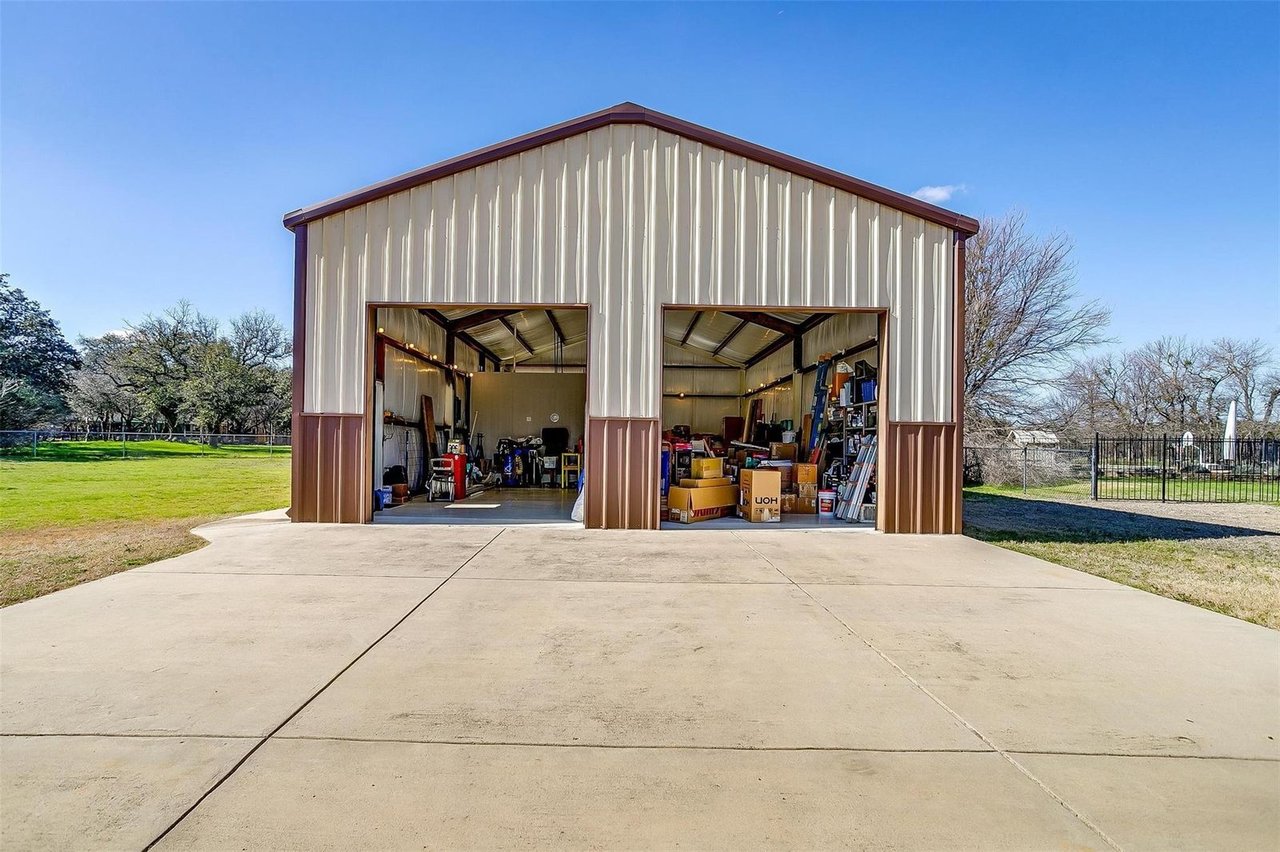
I appraised a property in Parker County a while back that had five separate shops on it. Each one was over 2,000 square feet. Ten thousand feet of shop space, and a perfectly ordinary house sitting in front of it.
The MLS described all of that with one word: Workshop.
That is the problem with every number you are about to read, and I want it in front of you before the first table rather than buried in a footnote. There is no field in the record for how big an outbuilding is. Building Area Total is populated on zero of 89,302 closings. A 400-square-foot uninsulated metal box and a four-thousand-foot conditioned shop with fourteen-foot doors and a finished office go into the database identically.
So I went looking for what the record does distinguish. It turns out there are three things, and each one moves the price more than most people would guess.
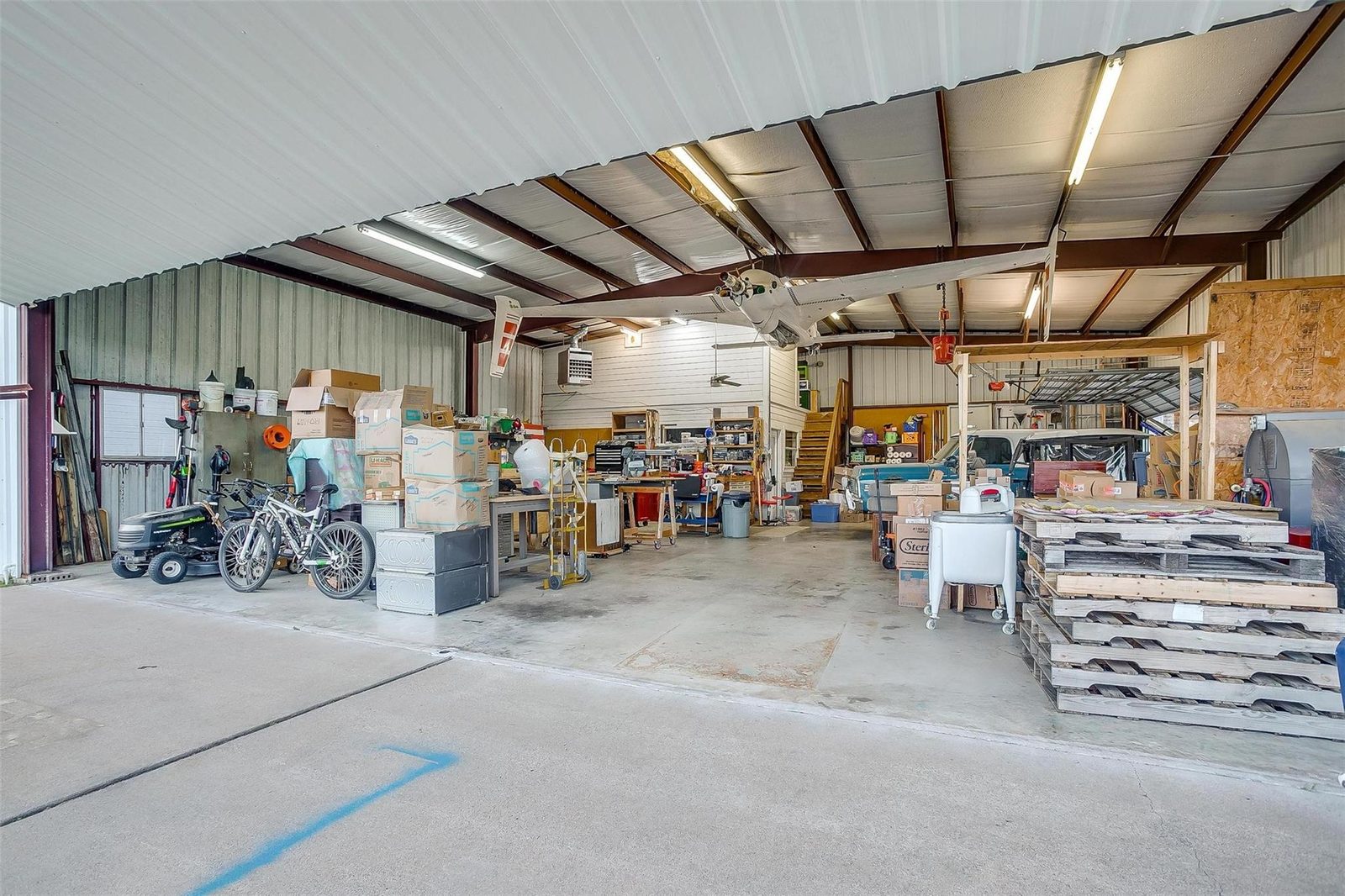
A shop in Granbury, from a sale of mine. Aircraft in the roof structure, a bench at the far end, a unit heater, stairs up to finished space. In the record, this and a 24×24 slab with one door are the same word. Every photograph here is from a house I have sold or helped a buyer purchase.
The MLS carries two separate entries for the same building: Workshop, and Workshop w/Electric. I pulled 2,125 workshop sales out of 89,302 across Dallas–Fort Worth and compared each one against its own neighbors in the same subdivision.
Workshop with electric | +6.1% | 1,763 sales |
Workshop, no power of record | +2.6% | 371 sales |
Storage shed, for comparison | +2.0% | 5,596 sales |
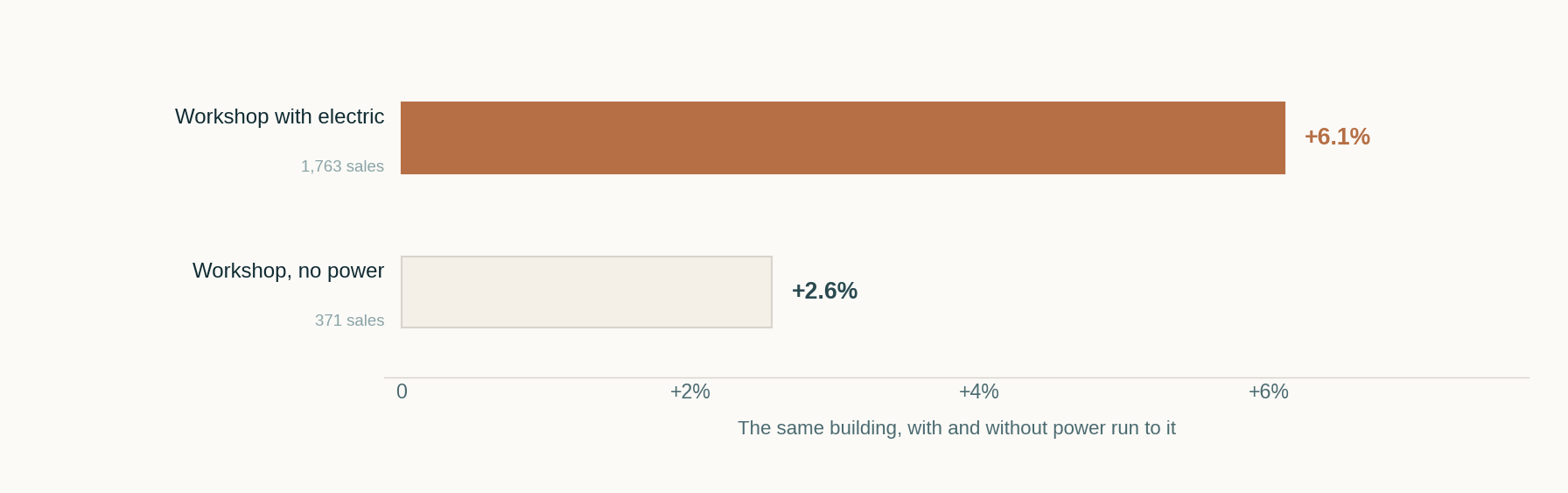
The same building. The difference is whether anybody ran a circuit to it.
More than double, for a trench and a subpanel.
Look at that third row, because it is the one that explains the first two. A workshop with no power adds essentially what a storage shed adds. Which tells you plainly what the market is paying for. It is not the structure. It is whether the structure can be used.
A shop without electricity is a large shed. You cannot work in it after dark, run a compressor, charge anything, weld, or heat it in January. The market prices that gap at about three and a half points — roughly $18,000 on the median property that has a shop.
Trenching a circuit out to an existing building and setting a subpanel is a few thousand dollars in most cases. I have not found anything else in three years of this research where the ratio between what a thing costs and what it returns is anywhere near that favorable.
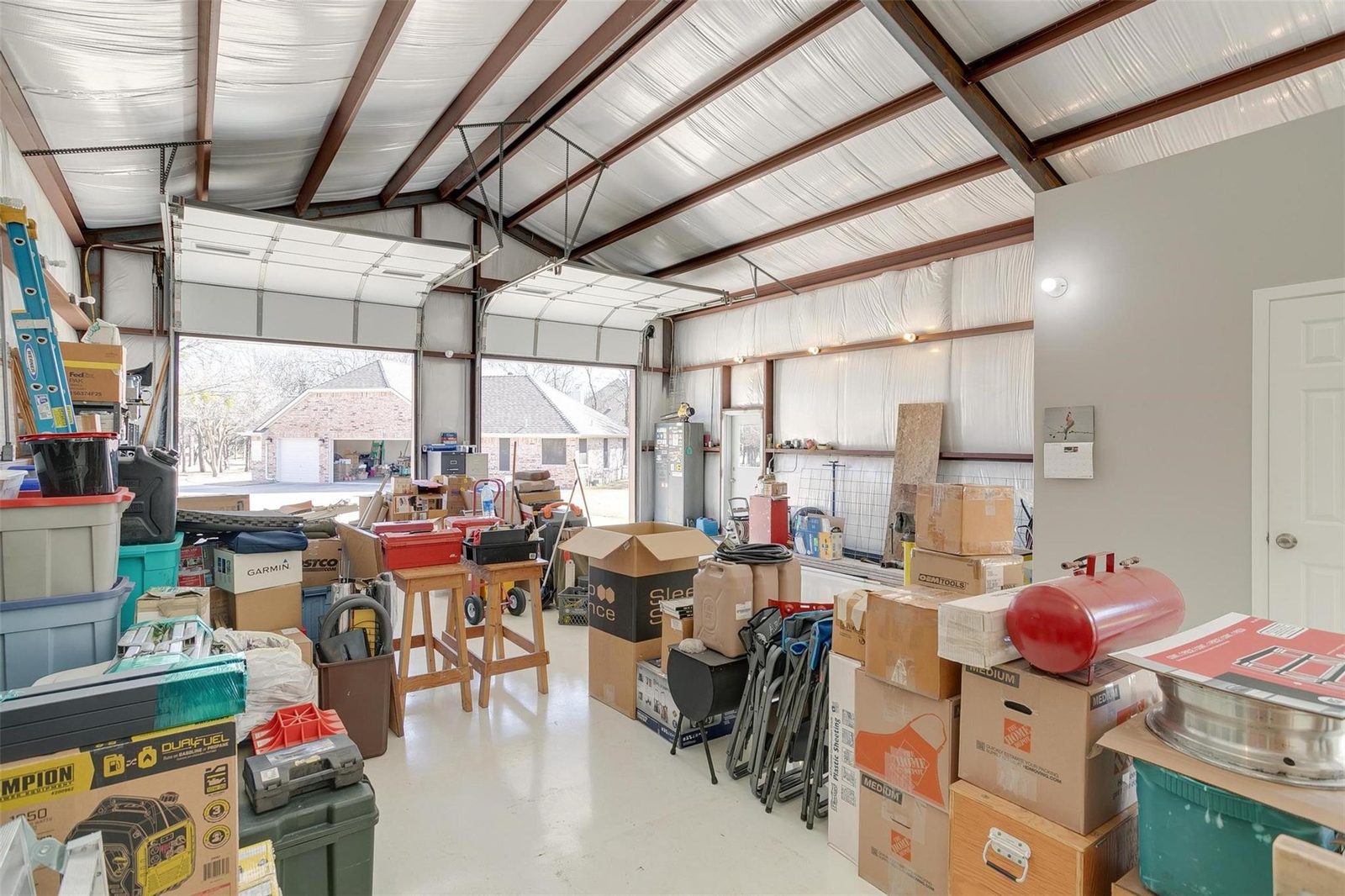
The same building inside. Lights, outlets, a panel, a water heater, a door through to a finished room — all of which the record compresses into one word.
And if your shop already has power and your listing says only "Workshop," that field is costing you money. It is a checkbox. Go fix it before you go to market.
Eave height is not recorded anywhere either. But height is mostly a means to an end — a taller building takes a taller roll-up door, and a taller door takes a motorhome, a gooseneck, a boat on a tandem trailer, or a commercial truck.
That is recorded, in the parking-features field, and it sorts into a gradient so clean it is hard to look away from.
RV garage (enclosed, necessarily tall) | +9.7% |
RV carport (covered, open-sided) | +6.7% |
Boat parking | +6.6% |
RV access / parking pad | +4.0% |
"Oversized," generic | +2.9% |
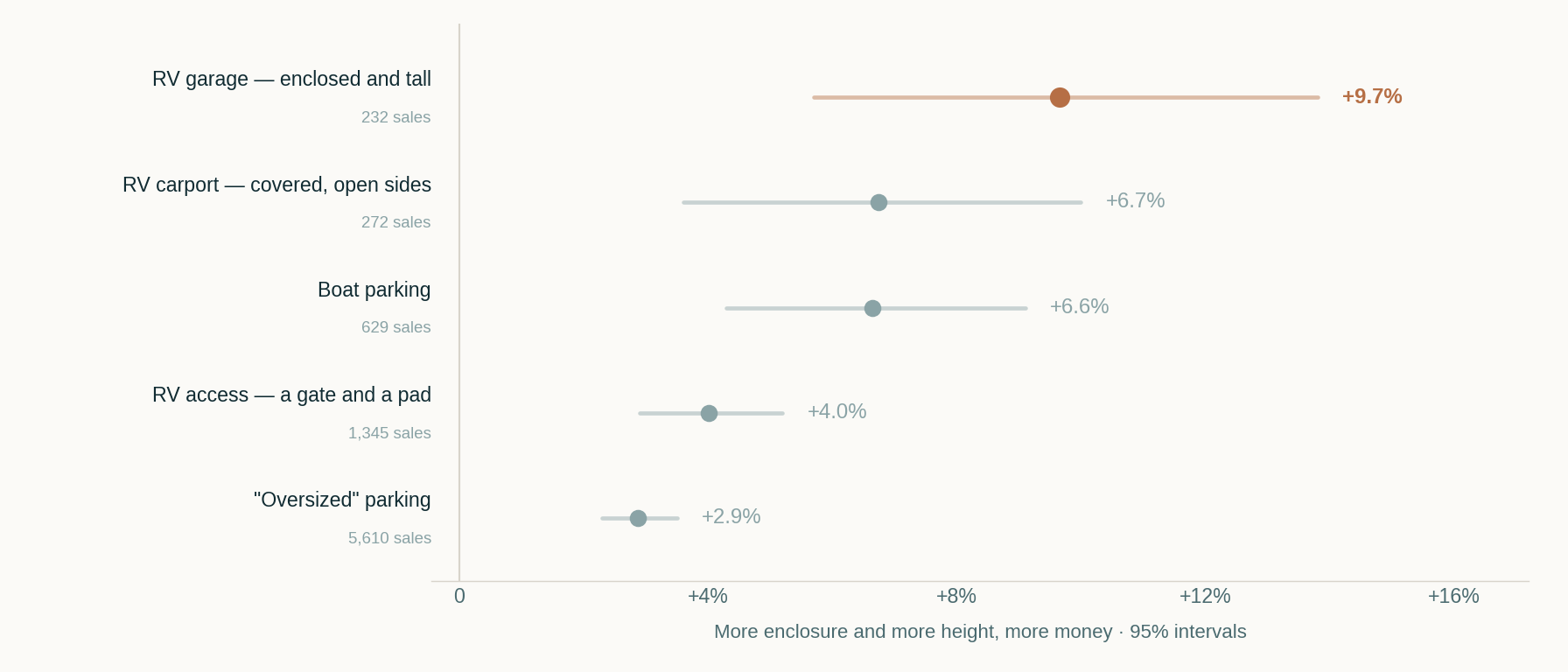
Space to park is worth something. Space to park under a roof is worth more. Space to park it enclosed — which is what height buys you — is worth most. An RV garage is the single highest figure of any parking feature in the data, and it beats a workshop, a barn and a second garage.
Split the workshops themselves the same way and you get the same answer. A shop with large-vehicle capability of record adds 8.2%. One without adds 3.5%. Same word, same field, more than double the money.
People who own motorhomes and commercial trucks tend to have more money, and their shops tend to sit on better properties. So is that 8.2% measuring the door, or the owner?
It is a fair question and it had to be answered rather than waved at, so I cut the data down to genuinely ordinary properties — lots under an acre, in subdivisions where the median house sells for under $500,000. No acreage, no luxury pockets.
The gap survives almost unchanged: +7.9% for a shop that takes a large vehicle, against +3.2% for a plain one.
So an average house in an average neighborhood with a tall shop really is worth materially more than the same house with a standard one. It is not just wealthy owners buying nicer land.
Which makes height a design decision rather than a detail. Going from a ten-foot eave to a fourteen at the framing stage is a small number. Doing it afterward is not a job at all — it is a new building.
Since nothing records square footage, I used two indirect measures: how many covered spaces the property reports, and how many separate structures the listing names. Both climb steadily, because both are getting at the same thing.
One outbuilding of record | +2.6% |
Two | +3.4% |
Three | +4.9% |
Four or more | +8.0% |
By covered spaces it runs 3.3%, 5.8%, then 10.1% at five or more.
That Parker County property with five shops sits in the top row of both tables. Calling what it has a "workshop" in the same breath as a 24×24 slab with a single roll-up door is why I would rather you took the pooled figure as the midpoint of a range running from about 2.6% to 10% than as a number to apply to anything.
One more proxy points the same direction. Shops with an accessory unit of record — a finished room, an office, an apartment over the bays — add 9.0% against 4.3% for those without.
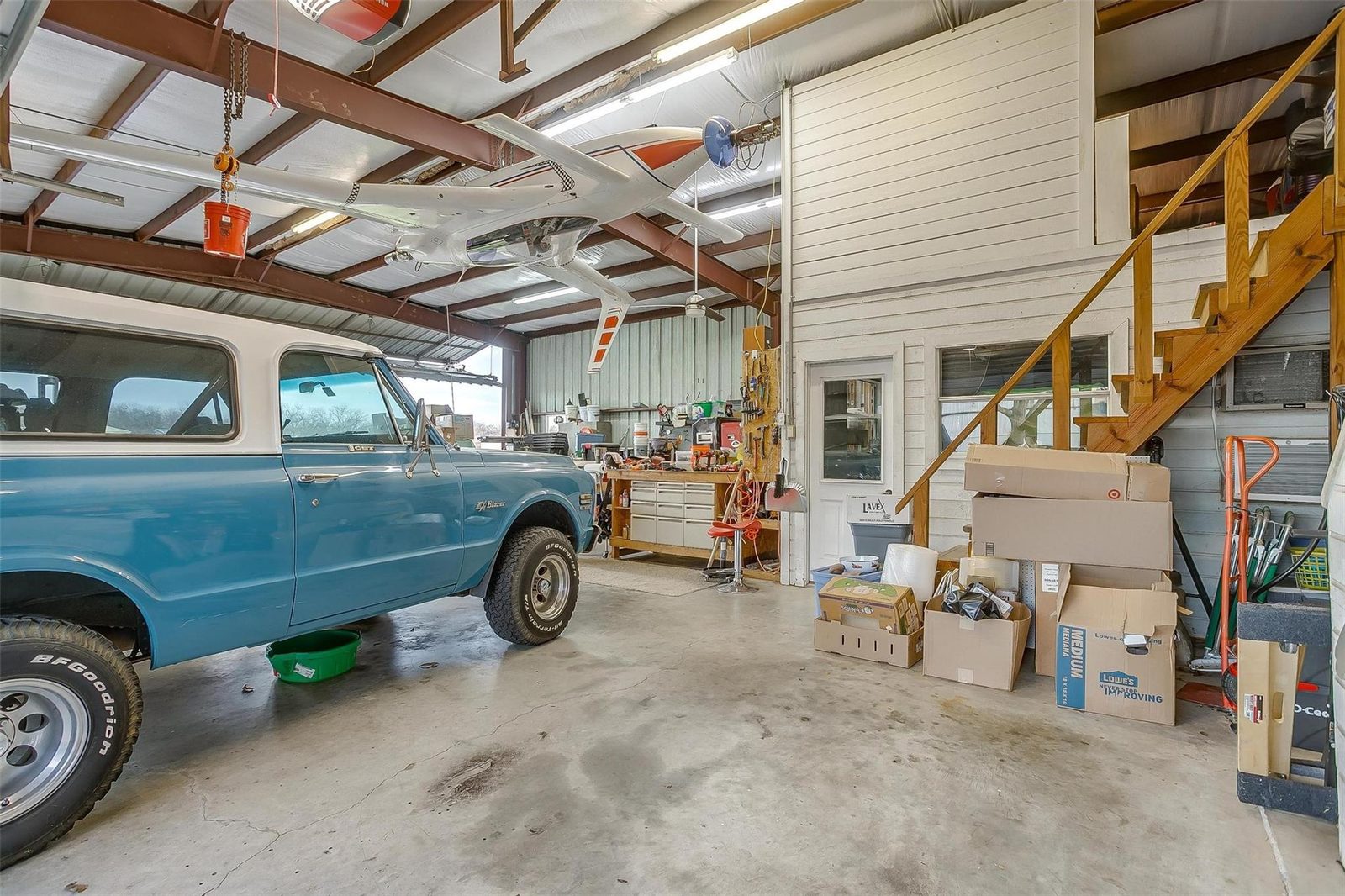
A shop in Granbury, from a sale of mine. The staircase on the right is the finding: height buys a second level, and a second level is what separates 9.0% from 4.3%.
Under a quarter acre | +3.4% |
Quarter acre to an acre | +5.5% |
One to five acres | +7.9% |
Five acres and up | +8.8% |
A shop on a tenth of an acre is storage. A shop on five acres is frequently why the buyer wanted five acres. The building has not changed. What changed is whether the property can support the use the building implies — equipment, trailers, livestock, a business run from home, room to work outside it.
This is the opposite of how a guest house behaves. Accessory units contribute about the same on a suburban lot as on acreage, because what they do for a buyer is the same either way. A shop is only as useful as the ground around it.
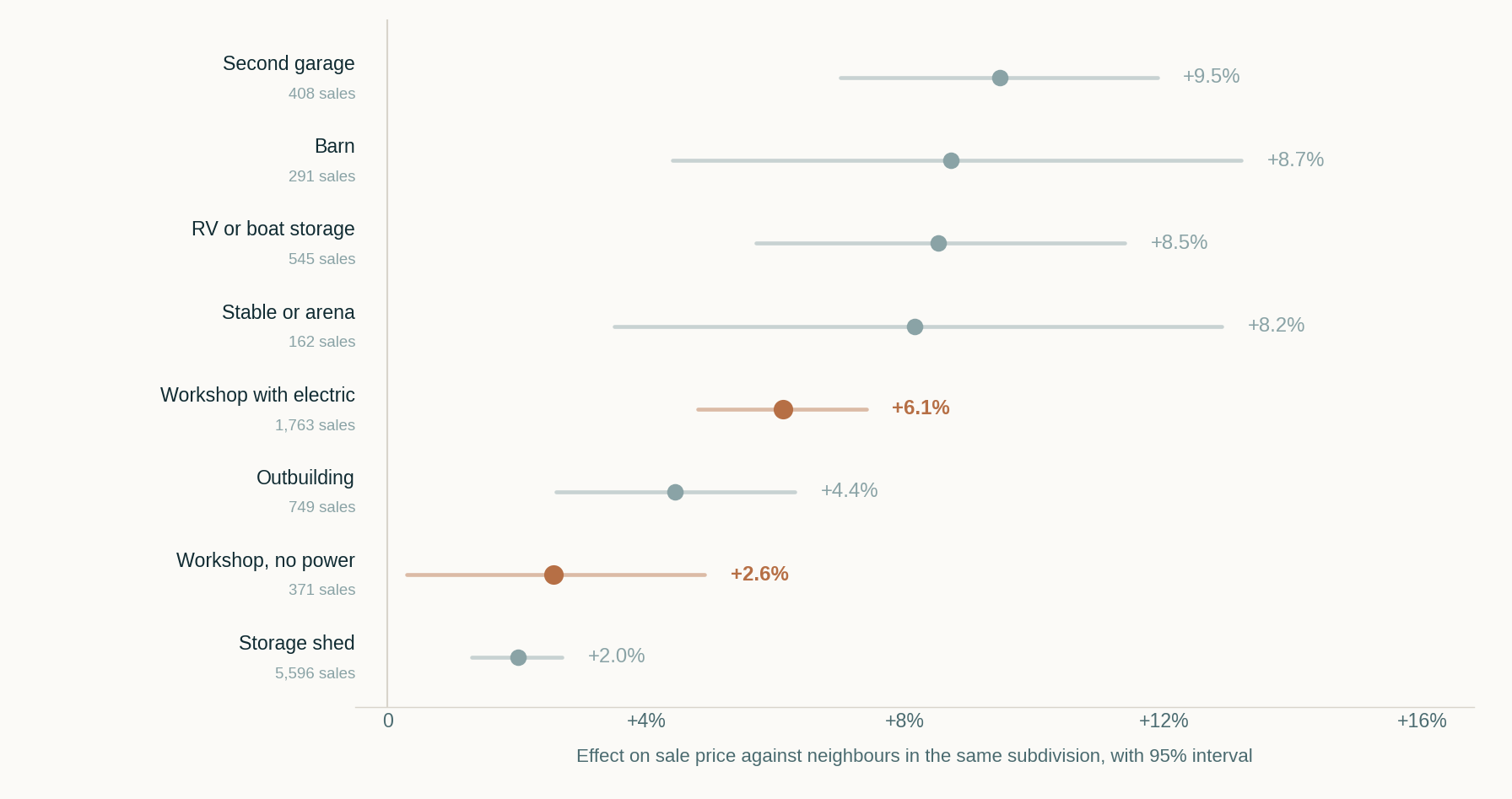
Two results here are worth stopping on.
A second garage outperforms a barn. +9.5% against +8.7%, on a larger sample. A suburban feature beating an acreage one, which is not what most people would guess. But a second garage is usually attached or near the house, finished, powered, and immediately usable by an ordinary buyer. A barn is none of those things for most of the market.
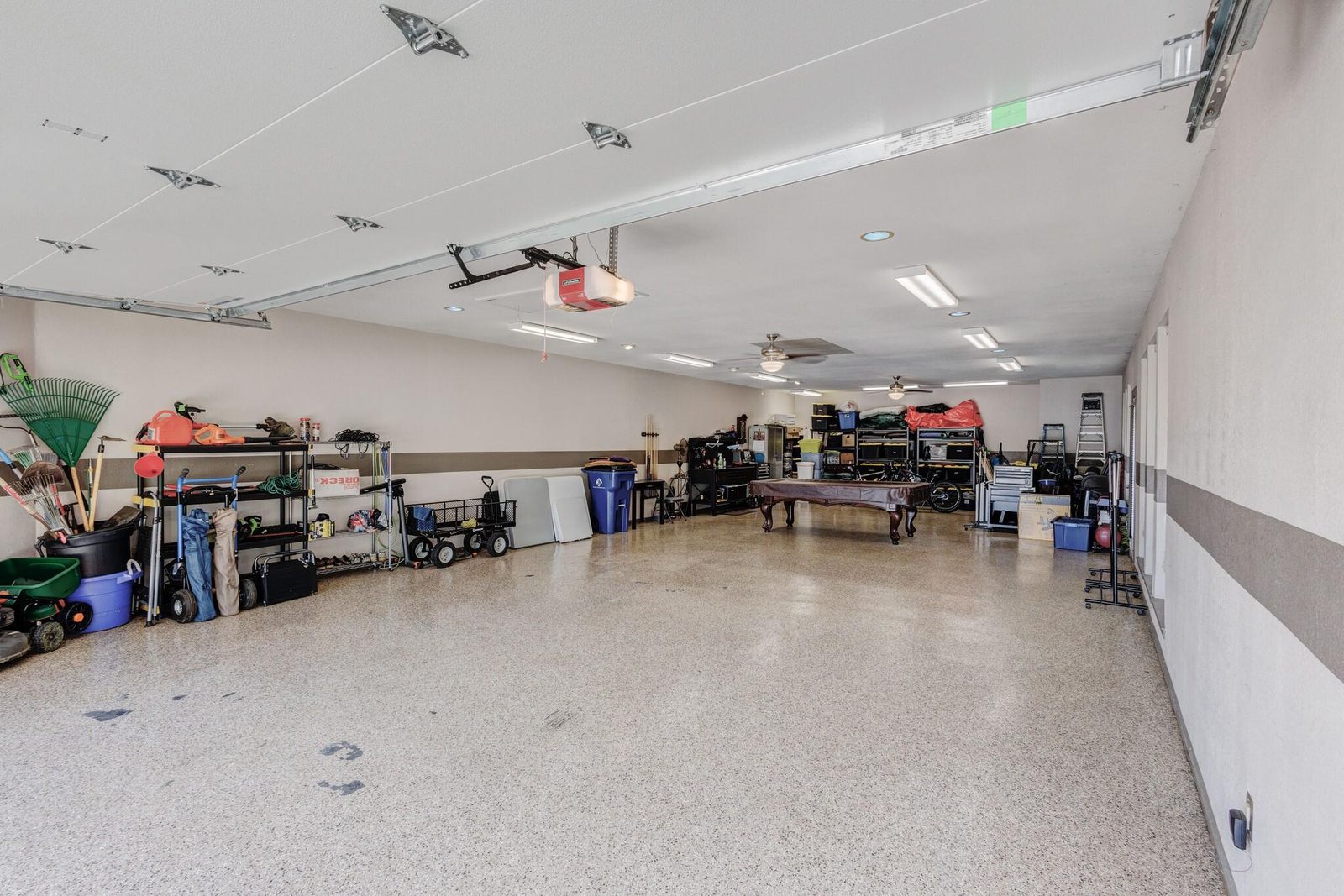
A finished second garage on Cardinal Ridge, bought by clients who had just sold the Granbury property above. Drywall, epoxy, climate, light — usable by any buyer the day they move in. That is why it outruns the barn.
A storage shed adds 2.0% on 5,596 sales — the largest sample in any of this work, and essentially the same figure as a workshop with no power. Back to the same point: the market pays for usability, not for square footage under a roof.
County | Share with a shop | Shop adds |
Parker | 9.5% | +7.6% |
Johnson | 4.7% | +7.0% |
Tarrant | 1.8% | +4.9% |
Hood | 6.3% | +2.8% (not distinguishable from zero) |
Wise | 14.3% | −1.9% (nothing) |
Parker County is the best market for a shop in North Texas and it is not close.
Wise County is the instructive one. It has the highest share of properties with a shop of anywhere here — 14.3% — and no measurable premium at all. When a feature gets close to standard, having one stops being a reason to pay more; not having one starts being a reason to pay less. Same inversion that happens with swimming pools above $1.2 million.
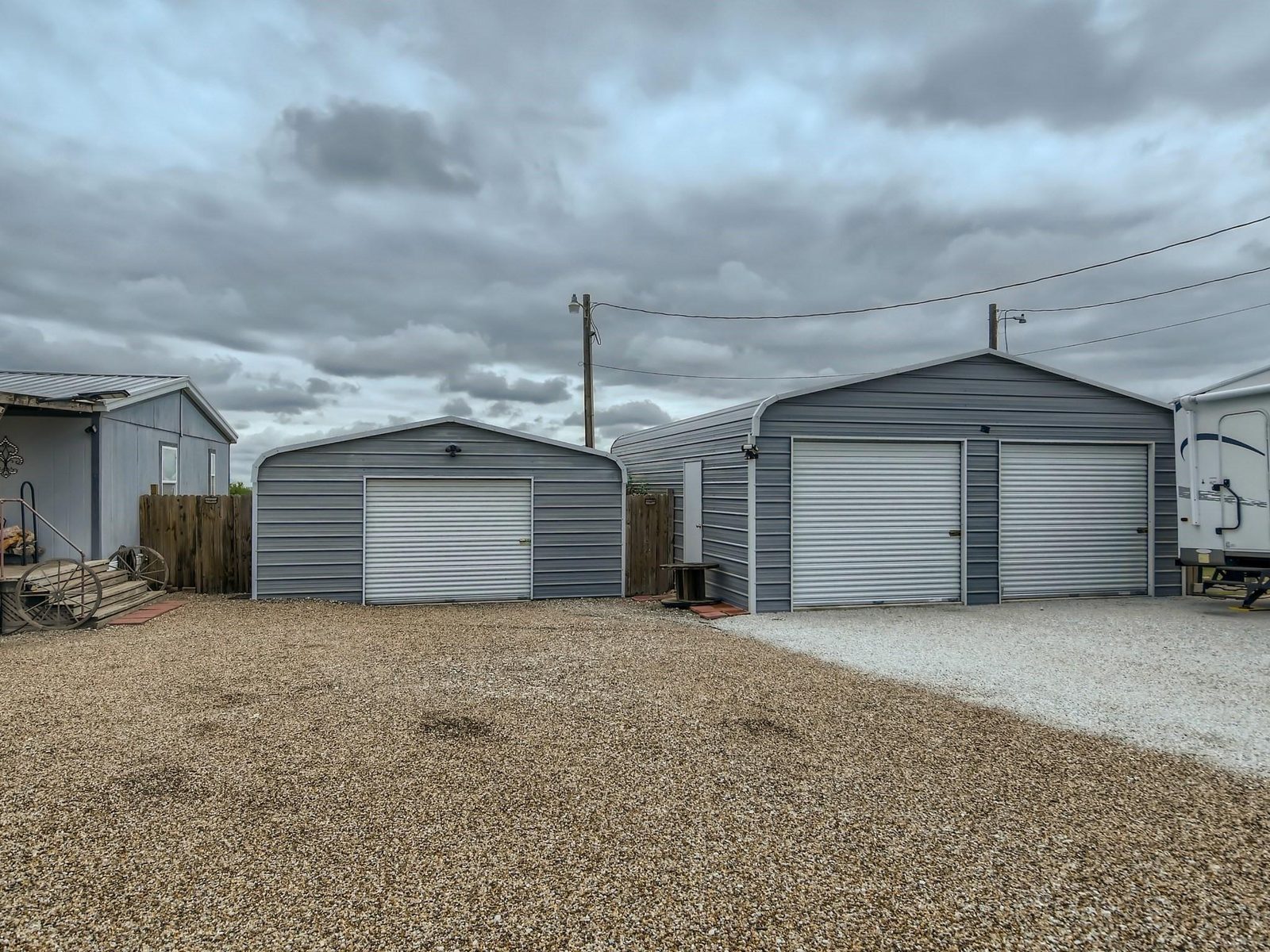
A property I sold in Wise County with several small shops on it. Nothing wrong with any of them — and in a county where 14.3% of sales have one, no premium attaches to having them.
Forty miles between Parker and Wise, and the answer flips. Be suspicious of anyone quoting you a countywide figure.
A turnkey 30×40 metal building in DFW — kit, erection, slab, basic doors — runs roughly $42,000 to $60,000. Shell-only installation is about $25 to $45 per square foot.
One local cost catches people out. On Dallas-area black clay, a thickened slab with turn-down footings runs $6 to $9 per square foot against $4 to $6 on sandy or limestone soil. On a 40×60 that is $18,000 to $30,000 of foundation before the building goes up. It is the same expansive-clay problem that adds ten to twenty-five thousand to a swimming pool here.
Against that, a powered shop adds about $32,400 on the median house that has one. So a modest 30×40 returns somewhere around half to three quarters of what it costs — better than a guest house, comparable to a pool, and far better than solar, at a fraction of either one's build cost in absolute terms.
What nobody publishes per square foot: insulation, electrical rough-in, roll-up doors by size or height, plumbing, or heating and cooling. Those get quoted per job and the ranges are wide enough that an average would be worse than no number at all. Price them from bids.
Run power to it, and do it first. It more than doubles what the building contributes. Nothing else on this page is close on cost-to-return.
Buy the height while it is cheap. A fourteen-foot eave over a ten-foot one costs a little at framing and cannot be added later at any sensible price. It is what lets the door take a motorhome, and it is what makes a second level possible.
Do not agonize over size. Scale does pay, but the returns come in steps — a second and third structure, more covered spaces — rather than smoothly with square footage. Build what you will use.
Finished space inside roughly doubles it. An office, a conditioned room, quarters over the bays: +9.0% against +4.3%.
Fill in the electric field. Three and a half points sitting in a checkbox.
Put the dimensions in the remarks. Size, eave height, roll-up door width and height, slab, insulation, climate control, three-phase service. None of it is in any structured field, so if you do not write it down, no buyer's search, no appraiser's grid and no data pull will ever see it. This is the single most under-described feature in the MLS.
Say what can fit inside. "Fits a 40-foot motorhome" is a sentence that does work. "Oversized garage" is not.
Expect slightly longer on market. Median 34 days to contract against 31. Worth more, to fewer buyers.
Measure the door yourself and bring whatever you intend to park in there, on paper. Owners routinely describe a shop by its footprint when the constraint is the opening.
And check the panel. "Workshop w/Electric" is an entry made by a listing agent, not an inspection. I verify it on site rather than trusting the field, and so should your inspector.
The technical version — confidence intervals, the county and structure-count tables in full, the published cost sources, and how I handle a shop in an appraisal report — is on my appraisal site: what a workshop adds to a property.
I am a Texas broker and a Certified Residential Appraiser. On a property where the shop is half of what the buyer is paying for, that means I can tell you what the building is worth in that market rather than what a cost schedule says it took to build — and whether the one you are about to put up will come back to you.
Browse active listings, or call or text (682) 207-4310, or send me a note.
Based on NTREIS closed sales of detached single-family homes across Dallas–Fort Worth, 2023 through September 2026 — 89,302 closings, 2,125 carrying a workshop of record. Premiums are measured within subdivisions containing both, holding living area, lot size, year built and sale date constant, with standard errors clustered by subdivision. Outbuilding size, eave height, door dimensions, insulation and climate control are not recorded in the MLS at all; large-vehicle capability is inferred from parking-features entries and is not a measurement of height. Build costs are published Texas ranges, not independent estimates or local bids. Nothing here is an appraisal or a valuation of any particular property.
 Tanglewood
 Crestwood
 Walsh Ranch
 Montserrat / Montrachet
 Bella Flora
 Edwards Ranch Riverhills
 Tavolo Park
 Ryan Place
 Fairmount
 Ridglea
 Ridglea North
 Ridgmar
 Westover Hills
Rivercrest Bluffs & River District
Westover Hills
Rivercrest Bluffs & River District
 Rivercrest, Monticello & North Hi Mount
 Mira Vista
Overton Park
Overton Woods
Westcliff
Arlington Heights
Benbrook
Ventana
Downtown
Linwood
Eagle Mountain & Marine Creek
Beltmill & Watersbend
Heritage & Alliance
Presidio & Tehama Ridge
Wedgwood
North Richland Hills
Hurst
Euless
Bedford
Grapevine
Westlake
Keller
Southlake
Colleyville
Arlington
Burleson
Crowley
Mansfield
Kennedale
Aledo
Weatherford
Azle
Granbury
Springtown
Cleburne
Joshua
Godley
Alvarado
Ponder
Krum
Waxahachie
Midlothian
Poolville
Decatur
Justin
Mira Vista
Overton Park
Overton Woods
Westcliff
Arlington Heights
Benbrook
Ventana
Downtown
Linwood
Eagle Mountain & Marine Creek
Beltmill & Watersbend
Heritage & Alliance
Presidio & Tehama Ridge
Wedgwood
North Richland Hills
Hurst
Euless
Bedford
Grapevine
Westlake
Keller
Southlake
Colleyville
Arlington
Burleson
Crowley
Mansfield
Kennedale
Aledo
Weatherford
Azle
Granbury
Springtown
Cleburne
Joshua
Godley
Alvarado
Ponder
Krum
Waxahachie
Midlothian
Poolville
Decatur
Justin
Stay up to date on the latest real estate trends.

H-E-B is coming to Chisholm Trail and Oakmont in late 2028. I measured six North Texas stores to find out what that does to home values. It doesn't — but it changes ho… Read more
Home Improvement
A shop with electricity adds about 6% of the sale price. The same building without power adds 2.6% — the same as a storage shed.
Home Improvement
2,002 accessory units measured. Having one adds about 7% — and how big it is adds nothing, so build the smallest one that does the job.
Seller Resources
Your old days on market follow you until you've been gone 30 days — then they vanish completely. 16,465 relisted DFW houses measured.

Home Improvement
About 9% of your price almost regardless of neighborhood — half to all of what one costs to build. And they sell eight days faster.
Buyer Resources
On a new build the listed tax is the vacant lot's bill, and it roughly quadruples in year two — about $526 a month on a $450,000 house.
Buyer Resources
Owned panels add about 3%. Leased panels add nothing — and a listing that doesn't say which gets priced like a lease.

Seller Resources
Your twenty acres are not worth ten times your neighbor's two. Per-acre price falls about a quarter every time a tract doubles.
Owner Resources
I listed one in North Richland Hills that sold in nine days at 99% of asking. The elevator wasn't why — and 121 sales out of 89,302 show why not.
I've trained three appraisers in this market, and every figure on this blog comes from closed sales I pull and model myself. The same analysis, applied to one address.